The difference between Facebook and Twitter

I just left the following comment at Shel Isreal’s latest blog post (read it first – the comment makes more sense in context):

I’d sign up for that.

Facebook is too unpredictable for my tastes. Even though i have people constantly asking me to friend them on it.

Twitter is a good example of balancing users and advertisers interests. Their private accounts are private. And advertising is only now becoming more of a piece of twitters strategy (@earlybird, promoted tweets etc). However, it is not being done at the users expense. Its an explicitly opt – in thing.

In other words, Twitter has respected its users, working its business model around them.

In the end, everybody wins.

I think it makes sense. Any thoughts?

A word about FaceBook privacy

I left this comment on Paul Bucheit’s Friendfeed Thread:

Paul: I get value out of having Twitter and FF completely public. Thats not the issue. The issue here is that FB was originally sold as a private service. Another thing. You and I may have seen value out of being completely public, but the only value to anyone about Grandma Indinana being completely public belongs to the knitting accessories advertisers.

And Followed it up with this one:

And for the record I don’t have a FB account. In the old days, snail mail mostly guaranteed privacy for your communications by virtue of the fact that your communiques were physically sealed by you. That essentially is the analogue version of FB pre privacy changes, albeit not at scale. In other words, privacy was implicit in the social convention of exchanging snail mails. With FB, people expected this social convention to extend, at slightly greater scale, to the online medium. Since, thats essentially how FB was marketed in the beginning. Now, FB has single handedly challenged the privacy implicit in this social convention, changing the default implied to a public one. That is the problem

I think the last comment sums things  up nicely. But do read that thread for a wide variety of opinions.

Data: Mine or Theirs?

Although I’m writing this under the fallout of  Scoble-Facebook, I don’t think the issue of who owns your data is either confined only to Digital identity or has been very well thought out.

First, a roundup of the various reactions:

It’s not about data portability. It’s about trust.

Offline, my friends and I share a mutual connection. Maybe it’s around work, maybe it’s around our kids or something in our past. Whatever it is, they’re my friend because they know something about me beyond what’s easily accessible to others. Keyword here is mutual. I know a bit about them too. Their relationship with me is unique as compared to their relationship with others.

Online, those lines are blurred. For what I would guess is at least 4,500 of the 5,000 “friends” Robert Scoble has on Facebook, he is the equivalent of a magazine publisher and you are his subscriber base/audience. He says it’s mutual and that’s the beauty of the social and connected web, but he only cares about you when you put something on the table that he’s interested in. It’s not about you. Yet, he’s “sitting” right next to your real friends, getting the same information about you that you’re sharing with them. If he takes that information and abuses it, however un- or good-intentioned, it serves you both right.

Robert Scoble valued his relationship with Plaxo more than he valued his relationship with his “friends,” otherwise he would have posted to them what he was doing with an experimental, alpha-quality and untested script before he did it…or he wouldn’t have done it at all.

Judi Sohn

I think there are two questions here. The first is whether users should be able to extract their data [including social graph data] from one service and import it into another. I personally believe the answer is Yes and this philosophy underlies what we’ve been working on at Windows Live and specifically the team I’m on which is responsible for the social graph contacts platform.

Dare Obasanjo

Then there is the oft-cited  post by Paul Buchheit (the guy who created Gmail).

Now I’m not on Facebook et al for a reason: data, in the case of a person,  is that person. Whereas data for iTunes is essentially  the signals sent to your sound card. Se the difference

Is it important to guard those things? Yes, or course. At the end of the day, its all you are left with if everything goes to hell: Your sense of self and identity, and your friends ( real friends, that is).

So we essentially have two options:

  1. Manage that data ourselves in a way that gives complete and utter control over every aspect of things
  2. Give our data over to a less than trustworthy service that essentially controls who you are, your identity ( on- and off-line) and who your freinds are and what your realtionship is with them

I’ll take option one any day of the week. Why? Becuase of control. It is all about control.

Plaxo may or may not keep your data after you opt-out ( i think its the former rather than the latter). Facebook has the awesome power of wiping out very single trace of you from its universe with a simple mouse-click. Add a hundred and one other web services that suck your data out of Google, Hotmail and the like.

There is a missing element in the above situations. Find it yet? And its not trust. Its control. And I mean, complete and utter control.

At least Twitter gives you more granular control( in terms of message recipients)  and has a proper API.

Better yet, Open ID, while somewhat flawed, is a brilliant idea insofar as you have a digital identity provided and vouchsafed by a trusted source ( AOL, for example). This blog is my digital identity ( since WP supports Open ID).  I can decide what to do with that identity, what to reveal, what to password protect. If I move on to from one blog to another, I can export all my posts and import them else where.

In short I have complete control of that Open ID identity (short of running my own webserver).

So because I have control I can never be in a Scoble snafu like that ( And I don’t care for the fact that Scoble was pressing FB’s buttons on purpose – he gave up his control over that data and he knew it).

In a  sense, its the MS DOS command line all over again. And  loss of control is like letting Vista hide the RUN command and the task manager and tickle itself silly with crashes.

Facebook and Microsoft

I was tempted to tell everyone who thought 15 big b’s for Facebook was excessive to look at Google’s $100 Billion valuation at IPO.

But then, it struck me, rather forcefully I might add, that Google and Facebook are completely unrelated in terms of price. Google, despite being mostly a search page, actually gets stuff done. Look at Google Earth, Product Search, Their Wifi  work both in San Francisco and with the FCC with regards to buying that spectrum, Desktop Search, Google Co-Op, Reader, Analytics, and, much, much more. The GooglePlex is a daily gathering of the brightest dev’s on the planet.

Google, in other words, has  plenty of reasons to justify its price tag.

What, pray, has Facebook done?

The question stands, but Kara Swisher beat me to the observation already (albeit from a slightly different angle):

Facebook is not Google: Although many in the tech sector make the comparison to the search giant, it is simply incorrect.

Is Facebook like Yahoo a bit? Certainly. A newfangled version of AOL? Absolutely! A very well done media play with all sorts of interactive bells and whistles hanging off of it? Yes, ma’am.

Indeed, it is growing its media business nicely, with $30 million in profits on $150 million in revenue.

But in comparative terms to the search giant, Facebook is a lemonade stand. Google brought in $3.9 billion in revenue in just the second quarter alone and, um, is increasing its dominance over the search sector in a mighty scary way.

Facebook, on the other hand, gets half its annual revenue right now from a sweetheart guaranteed revenue deal with, drum roll, Microsoft. No matter what either Facebook or Microsoft says, it is a money-losing deal for Microsoft so far.

How do I know this? According to many sources, Google is struggling to make ends meet in its own sweetheart guaranteed ad deal with Facebook rival MySpace, which is much larger, and Google has the best monetization engine out there.

Thinking about Facebook

1279612562_037da79269

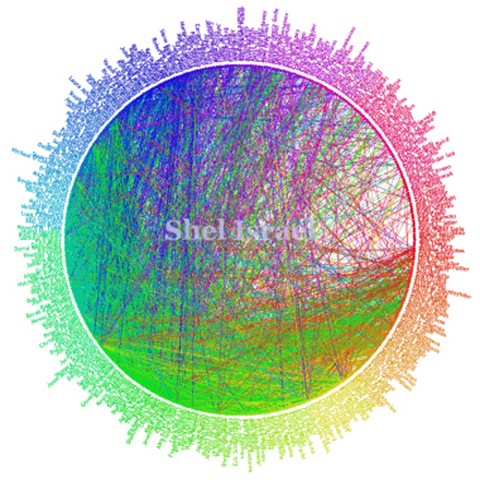
Above is Shel Isreal’s Friendwheel of his Facebook Contacts . In the interests of disclosure, I’m not on it. In fact I’m not even on Facebook. And I’m exploring why in this post.

The above picture shows a true social network, pardon the term for a minute. Most people who know Shel know others in his contact list as well.

There are a few hundred contacts here, and it is a reasonable number of people to know and be in contact with. See the difference between being like Scoble who has 5000 people who happen to read his blog and having a shortlist of  “real” people that you know personally and do business with?

If you sit down and consider this for a moment, you’ll see the logic of that statement. We all have  lists of contacts, in Outlook, Messenger, in our Mobile Phones or perhaps written in a phonebook. They are there because we know these people personally and communicate with them often.

Now I would not have the email address and phone number of my readers ( assuming I have regulars who read my blog) on my mobile in Messenger or in Outlook ( actually Google Mail, now).

Why should it be any different on FaceBook???? Why do people add contacts that they’ve never met in person?

 (And Scoble, by the very nature of his work, needs to keep a pulse on the Valley – thus his large contact list. I was just using him as an example)

Now I DO concede the point that this is exactly what happens in business – people exchange cards on a whim in the hope of acquiring business or services from someone else.

Which leads us to the next question? What do you characterize Facebook as? Is Shel’s Facebook Contacts made up mostly of froends, ore mostly of people in the same line of work ( I guess its the latter)? In other words, is Facebook a social of a business contact site?

I ask since Facebook was originally a students only site.

So why am I not on Facebook? Simple. I don’t need to be.

PS. I addition to the above, where does Facebook add value? If its business-oriented how does it do this? If its Socially-oriented, how?

The Echo Chamber

I read this post from Shel Holtz last night suggesting that the Blogosphere is akin to an echo chamber. At this point I’d like to congratulate Google for NOT including search with Google Reader since I had to go looking for this post manually from my long list of feeds, which wasn’t easy – but I digress.

So, bearing in mind that I’m doing some echoing myself here:

One of the dominant criticisms of the blogosphere is that bloggers just write about what other bloggers have written about; it’s nothing more than a huge echo chamber.

I’ll give you an example of said effect. last week, Windows Home Server was released to manufacturing. I got virtually the same post from the WHS Team Blog, We got Served, Ms Home Server Blog and Ramblings of a Home Server Tester. And by the way, they all arrived in my feed reader at the same time.

Shel argues that The Echo Chamber Effect is nonsense:

I don’t buy the echo-chamber argument. Based on the 10% rule, which suggests that 10% of a blog’s (or Wikipedia’s or any other collaborative property’s) readers contribute to the content, that leaves 90% who are passive consumers of the content.


And gives an example:

read a blog called Brand to be Determined. Many of you—readers of this blog—probably don’t. So when I point you to a resource I learned about on Brand to be Determined, you’re getting information you probably wouldn’t have otherwise received.

Take Facebook as an example.

The tech blogoshpere has run amok with Facebook posts (A Google custom search of my 140 subscriptions gives me 1500 posts, a Google blog search gives me 437,000 posts).  Facebook has been analyzed from every conceivable angle, probably several times over.

So if I now write a post echoing Scoble and a few others, do I add value to the conversation, or noise? 

Lets Face It

Om Malik takes a look at Facebook histeria:

Take Bay Partners as an example. A sedate venture fund that typically invests in semiconductor companies and infrastructure start-ups has started a new effort that invests exclusively in Facebook applications. The right applicants can get anywhere from $25,000 to $250,000 as an investment for their applications.

The collateral of this project, imaginatively dubbed App Factory, is interesting, cringe-worthy reading filled with clichés like “application entrepreneurs” and “affect adoption, virality, and usage.” Here is just a nugget of wisdom from the press release announcing this new funding strategy. 

 A fully baked business model is also not a requirement, as long as there are reasonable theories and approaches that can be explored together.

Putting my newly acquired Hebrew Yiddish skills to use, I say, Oy-vey!

Are we looking at another dot com bubble?

Shel Isreal asks the same question, in connection to Ning:

But Michael Arrington says that it’s first external financing round was $44 million and that the company’s post-money value is $214  million. This scares me.  It scares me because I cannot conceive of any possible argument that this company is worth nearly a quarter billion dollars. Even considering the value of Marc’s personal brand, the upside expectation seems to me to defy reality.

I am a survivor of the Great Dotcom Bubble. I remember hearing company valuations that seemed silly or worse to me, and I recall being shouted at because “I just didn’t get it.” What I did get was bubble splatter all over my nice PR guy suit, and then a nice long rest from work.

The Ning valuation scares me. I just don’t get it. I hope someone else does

Well? Are We?

Update:  AppFactory Q&A here