Google Just Made My Life Easier

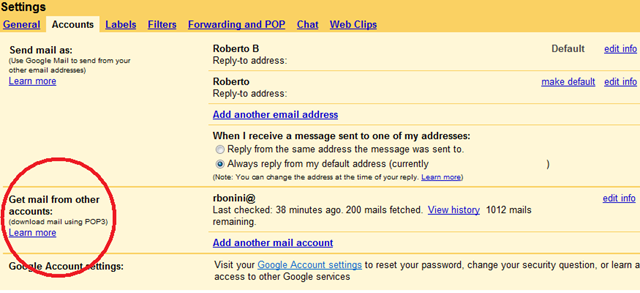
I’m not sure anyone noticed since I haven’t read any blogs on it. But Google just added a nifty option to bring mail from other pop3 email accounts into GoogleMail.

image

[addresses have been redacted out – thanks Paint!!!]

This is really useful as I can turn GoogleMail into a Personal Email Nerve Center. And I don’t need to resort to hacks either. Mail can either be sent to the inbox or labeled and archived. And you can specify the reply-to-address associated with the account.

It essentially means that my email is independent of the individual email services I use (not sure it works with Hotmail).

So using Googelmail is now a really compelling option. Its easier than running your own Exchange or other mail server. I mean think of all the costs associated with a server that evaporate. Electricity, server hardware, software licenses, service and support.

Now obviously a work email account should come straight into Outlook, ThunderBird or your friendly email application of choice ( aside form Googlemail, naturally).

Since the whole family has a Googlemail account, I’m setting this up for everyone (even if I do have to download  the final deluge of mail to Outlook for the pre- web 2.0 style of accessing mail they’re used to 🙂 ).

Now on a related note, what does this do for Chandler – Mitch Kapor’s total redefinition of the Personal Information Manager in the spirit of Lotus 1-2-3?

The thing is, can Google and Chandler get along? I.e can chandler use Google as the server for you stuff? On first look, you might think I’m joking. Scott Rosenburg’s Dreaming in Code makes the point that Cosmo Server was written specifically to preserve the Chandler-ness of the application data. But that’s not what I’m saying. The Application, Presentation and Data Access Logic remain on the local Application. The Application simply uses Google as a data store. Just an idea. My 2 cents.

Quote of the Day

On Youtube’s imminent demise:

Traditional media can give people what they want – a comprehensive collection of high-quality video, free of spam and crappy user-generated content. While we’re longtime advocates of user-generated media, a lot of it’s crap – and people don’t want to wade through crap when they’re looking for their Lost fix.

-Podcasting News

I agree.

Go on. Read the whole post.

Random Thoughts for the Day

I might make this a regular thing.

  • I was at Costa’s this afternoon and a guy walks in with a  brand new iMac. Must have been at least a 20" if not more. never felt so jealous in my life. He must have got it from the Glasgow Apple Store. I’ve been meaning to go past, but haven’t had the time yet
  • My 19" Xerox TFT died today. Its a display model that I got slightly cheaper and have had it for 2 years. Its one of those lookers -black with a glass front so its completely flat. Damned thing. Multi-monitor setup anyone??
  • TCP/IP – spent the weekend doing revision on it. No wonder the Vista networking team re-wrote it.
  • Wouldn’t it be easier to replace RAM if you could plug the old or new RAM into a USB port and use it with ReadyBoost??? I mean, you need every megabyte of RAM you can find these days.
  • I keep thinking that you can do so much with technology around the home (RSS on your TV for example). Its just so difficult. Windows or Linux?? Windows Home Server??? Media Centre Edition??? Mac Mini with Front Row??
  • I’m starting to think that a separate machine running Media Centre Edition would be better than SageTv for Windows Home Server. I’m fighting SageTv tooth and nail to get it working properly ( EPG and all).It should be easier than this. Might get a refund
  • Could we please have a virtualisation hardware solution for small business/ home. It’d be cheaper than buying the MCE Server.
  • How many Vista Sidebar gadgets are actually useful??Google desktop is much, much better at useful gadgets. The mail gadgets for GD actually tells me when any new email arrives ( even if its automatically archived).
  • And could we please get a free sunclock for either sidebar?? You know, the ones that show where its day and where its night on a map of the world.
  • Also, back to sidebars, I’ve noticed that Google desktop loads its widgets off the Internet. You could theoretically see your widgets at any PC with GD installed if you’re logged in. Which is logical for Google in becoming the hub on which our lives revolve. I wouldn’t be surprised if they were building a HealthVault competitor – on the web of course.
  • I’m seriously considering the iPod Touch. DRM or no DRM. iTunes integration or no integration. The Design blows me away everytime. Why did el Jobso have to come up with a design that puts every other portable music player ( and iPod, mind you) to shame?????? And don’t tell me the iPhone is the best iPod to have. I think I’ll put that SageTv refund money to wards it if it comes to that)

Good Microsoft, Bad Google??

Taking a break from the innards of TCP/IP, I bring you two interesting blog posts.

First Verturebeat’s Matt Marshall asks: In history revision, Microsoft now a friend of the valley?

Second, Robert Cringely opines: The Future is Cloudy: Google’s plan to host ALL our applications.

Both may seem to be unrelated, but lets consider them both.

Matt says:

But now that Google has emerged as the all-pervasive menace, Microsoft has been transformed into an aging, less threatening knight, albeit with pockets and interests deep enough to help you against the Google onslaught. Microsoft’s alliance with Facebook — which calls for Microsoft to invest $240M in that company — has capped the transition.

Interesting inversion, don’t you think? Kind of like America springing to plucky little Britain’s aid after Pearl Harbor. In this case Microsoft’s Pearl Harbor was Google’s huge IPO and the raft of  highly successfully geek-drool-inducing products they released. And the Britons are everyone else in the Valley that have yet to go over the the Dark Side ( 🙂 ).

Think of the perceptive transformation that Microsoft has gone through. 3000 Microsoft Blogs (last I checked, which was while ago) and Robert Scoble have done loads to bring a human face to Microsoft. I remember once emailing Robert just after Office Live had its public debut for some specific details ( I was looking for a platform for a company web presence) and got a reply from the program manager 8 hours later.

Microsoft has done plenty to reach out to the community. Think of Mix06 and Mix07. The entire conference is on video with slides available from visitmix.org so anyone can take a look (I’ve still to get round to watch the sessions I downloaded 🙂 ).

Now take Robert Cringely. He looks at what Google’s Data Centre build out means, taken together with their MySQL contributions and their agreement with IBM to promote Cloud Computing to Universities.

By working with IBM to promote cloud computing to universities, Google is accomplishing two very important goals. It will first put them in touch with every graduate student doing work Google might find interesting. So it is first a hiring tool. But by teaching students about cloud computing Google and IBM are also seeding the technology in the companies where those students will take their first jobs after graduation. Five years from now cloud computing will be ubiquitous primarily for this reason.

But Google wants us to embrace not just cloud computing but Google’s version of cloud computing, the hooks for which will be in every modern operating system by mid-2009, spread not by Google but by a trusted open source vendor, MySQL AB.

Mid-2009 will also see the culmination of Google’s huge server build-out. The company is building data centers large and small around the world and populating them with what will ultimately be millions of generic servers. THAT’s when things will get really interesting. Imagine a much more user-friendly version of Amazon’s EC2 and S3 services, only spread across 10 or more times as many machines. And as with all its services, Google will offer free versions at the bottom for consumers and paid, but still cost-effective versions nearer the top for businesses and education.

Google’s goal here is to help us, of course, but along the way the company will have marginalized most higher-end computing vendors, especially Microsoft. They will have also made us totally dependent on Google services in such a way that we’ll never, ever, be able to extricate ourselves. We’ll be slaves, but happy slaves, and Google will come to dominate all computing for the next generation.

Now if Microsoft ever tried anything like this, I’d probably have to turn off comments to avoid the Death-To-Microsoft chants from the virtual mob.

This, of course, risks taking a left turn into the whole Dependency on Microsoft Question. But, for the sake of argument Leopard and Linus’ Every Flavor Linux settle that question just fine.

I use Google Mail for correspondence, Calendar for scheduling , Search for the obvious reason, iGoogle for my dashboard-view-on-the-world, Webmaster Tools.

What if we’re all reduce to running dumb terminal emulators connected to our Google-Instance on their servers? Fascinating idea, I’m sure. I mean what’s not to like about carrying your whole computer around with your Google Account and password (would save my shoulders lots of grief that’s for sure 🙂 )???

Taken with Google’s insatiable hunger for startups, is Google Microsoft-that-everyone-loves-to-hate 2.0???

Facebook and Microsoft

I was tempted to tell everyone who thought 15 big b’s for Facebook was excessive to look at Google’s $100 Billion valuation at IPO.

But then, it struck me, rather forcefully I might add, that Google and Facebook are completely unrelated in terms of price. Google, despite being mostly a search page, actually gets stuff done. Look at Google Earth, Product Search, Their Wifi  work both in San Francisco and with the FCC with regards to buying that spectrum, Desktop Search, Google Co-Op, Reader, Analytics, and, much, much more. The GooglePlex is a daily gathering of the brightest dev’s on the planet.

Google, in other words, has  plenty of reasons to justify its price tag.

What, pray, has Facebook done?

The question stands, but Kara Swisher beat me to the observation already (albeit from a slightly different angle):

Facebook is not Google: Although many in the tech sector make the comparison to the search giant, it is simply incorrect.

Is Facebook like Yahoo a bit? Certainly. A newfangled version of AOL? Absolutely! A very well done media play with all sorts of interactive bells and whistles hanging off of it? Yes, ma’am.

Indeed, it is growing its media business nicely, with $30 million in profits on $150 million in revenue.

But in comparative terms to the search giant, Facebook is a lemonade stand. Google brought in $3.9 billion in revenue in just the second quarter alone and, um, is increasing its dominance over the search sector in a mighty scary way.

Facebook, on the other hand, gets half its annual revenue right now from a sweetheart guaranteed revenue deal with, drum roll, Microsoft. No matter what either Facebook or Microsoft says, it is a money-losing deal for Microsoft so far.

How do I know this? According to many sources, Google is struggling to make ends meet in its own sweetheart guaranteed ad deal with Facebook rival MySpace, which is much larger, and Google has the best monetization engine out there.

iPhone Hacks: What Will Apple Do?

Despite the clear lack of a SDK, intrepid iPhone hackers err developers haven’t stopped churning out thier stuff. Here’s a small list from todays TUAW RSS feed:

This posses an interesting dilemma for Apple. Since all this stuff clearly isn’t intended to be done, Apple can either crack down on it by having hacked iPhones simply stop working( a la Microsoft) or they can go Google’s way and turn a blind eye.

Perversely, Apple will get more consumer attention and popularity at the cost of a potential showdown with AT&T ( who are obviously the very bad guys behind the draconian lockdown of said mobile device 😉 ).

So the question is: What will Apple Do??

Update: TUAW Asks the same Question:

the iPhone apps are arriving en masse. So far the list includes tools like a working Apache we server, python, shell — and a pile of associated binaries like ls, rm, echo, csh, and tsh — and while these might not be terribly thrilling for Joe everyday user, they are a pretty kicking start. We could start to see all manner of fun stuff arriving in the coming weeks, unless, of course, Apple pulls the plug via an update. Again, we won’t link to the goods, but a wee bit of searching should get you on your way

The Echo Chamber

I read this post from Shel Holtz last night suggesting that the Blogosphere is akin to an echo chamber. At this point I’d like to congratulate Google for NOT including search with Google Reader since I had to go looking for this post manually from my long list of feeds, which wasn’t easy – but I digress.

So, bearing in mind that I’m doing some echoing myself here:

One of the dominant criticisms of the blogosphere is that bloggers just write about what other bloggers have written about; it’s nothing more than a huge echo chamber.

I’ll give you an example of said effect. last week, Windows Home Server was released to manufacturing. I got virtually the same post from the WHS Team Blog, We got Served, Ms Home Server Blog and Ramblings of a Home Server Tester. And by the way, they all arrived in my feed reader at the same time.

Shel argues that The Echo Chamber Effect is nonsense:

I don’t buy the echo-chamber argument. Based on the 10% rule, which suggests that 10% of a blog’s (or Wikipedia’s or any other collaborative property’s) readers contribute to the content, that leaves 90% who are passive consumers of the content.


And gives an example:

read a blog called Brand to be Determined. Many of you—readers of this blog—probably don’t. So when I point you to a resource I learned about on Brand to be Determined, you’re getting information you probably wouldn’t have otherwise received.

Take Facebook as an example.

The tech blogoshpere has run amok with Facebook posts (A Google custom search of my 140 subscriptions gives me 1500 posts, a Google blog search gives me 437,000 posts).  Facebook has been analyzed from every conceivable angle, probably several times over.

So if I now write a post echoing Scoble and a few others, do I add value to the conversation, or noise? 

Googlemail Hacks

Lifehacker helpfully has a top ten list of Googlemail hacks.

Now, by my count, there are 3 Windows (read IE) hacks. Only 3. This seriously has me considering switching back to Firefox as my main browser.

Besides the fact that Firefox has a huge amount of flexibility from RSS readers to Sports tickers, its the fact that the web application itself can be hacked (I know, “hacked” sounds bad since we consider hacking to result in digital damage). All of these “hacks” are genuine improvements to Googlemail:

  • Check multiple accounts with Gmail Manager (Firefox)
  • Gmail Encryption (Firefox)
  • Saved Searches (Firefox)
  • Drag and drop attachment upload (Firefox)
  • GmailDrive file manager (Mac/Windows/Firefox)

Lifehacker comments that:

From the get-go Google’s stayed out of developers’ way and turned a blind eye to unofficial Gmail add-ons, even ones that may very well violate its terms of service. Smart move: Google’s high tolerance for third-party apps have only helped Gmail win the hearts of power users and tweakers everywhere.

and I agree. if only IE devs had the same attitude.

Scoble’s Phantom Links

You may or may not have read Scoble rant here about Techmeme not putting most linked stories on its front page.

TechMeme (which started out as a blog news engine) has totally switched its focus away from blogs. I’m tracking the Plaxo news. I was among the first two sites out with news about Plaxo’s new 3.0 platform. I have the only videos. Posted two of them. I have one of the first real reviews. Google’s blog search shows I have the most inbound links. Om Malik, who posted a story about Plaxo two hours after I did, even linked to me.

Yet the top article right now? One by the Register which doesn’t even have comments and doesn’t link out and doesn’t have screen captures (like other articles do) and doesn’t have video and doesn’t even have any real news.

You can read Doc Searls respond to Scoble about this:

And some don’t bother to play at all. Yours truly, for example. I don’t follow Techmeme, Digg, Memeorandum or TechCrunch any more than I once didn’t follow Daypop or Slashdot. Somewhere way back there I began following topics more than bloggers. Last couple of weeks or so, for example, I followed Supernova and VRM, together, because VRM was a subject of special interest to me that was discussed at Supernova. If in the course of looking into topics I run into one of the popularity-following (or -making) sites, I’ll go there. But I don’t start there.

Every one of these valuation engines has its own weighting system, of course. But many links from many bloggers does not true authority make, especially when the system is gamed in the manner that Kent nails rather well. We’ve gone from SEO (search engine optimization) to BVE (buzz volume elevation). The results are often useful, but they can also turn the blogosphere into high school.

In his post he links to Kent Newsome’s hilarious post about this:

Scoble says he has all the inbound links and ought to be the top story about whatever the top story is at the moment.  He’s said basically the same thing before.  Here’s the problem with that: Scoble could write a post about arm farting and 30 or 40 people would immediately link to it, hoping he might link back.  Scoble has more yes men than Michael Corleone and Michael Arrington combined.

In other words, all those people linking wildly to Scoble aren’t doing so because they think he is the world’s greatest authority on arm farting.  They are simply holding out their hands eagerly and hoping Scoble will shake it (via a link) as he walks by.  Getting a link from Scoble is almost as good as getting arrested with Paris Hilton.  It’s not Scoble’s fault he’s the king of the blogosphere any more than it’s Paris Hilton’s fault she’s in jail.


But none of this is a sound basis for deciding what is top news and what isn’t.  There needs to be more to it.  There needs to be a balance between popularity, authority, freshness and inclusion.  Most of the target audience for Techmeme already subscribe to Scoble’s blog.  They are at Techmeme looking to see what others are saying about various topics.  And let’s not kid ourselves, a ton of Techmeme readers are bloggers who want to be included in the conversation.  To remove the opportunity for inclusion would change Techmeme in a fundamental and adverse way

Unfortunately no one has yet come up with a magic silver bullet or ( if I may mix my metaphors) the PageRank for blogs. Its a though problem to solve. Do you crawl the linking websites to see if they actually talking about Scoble’s expertise Arm Farting, or is it simply a link farm blog? Come to think of it, how do translate a blogs authority? Page views? Subscriber stats (Google will have no doubt added this in to their blog search)?

Authority is more perception than anything else.  You can’t get an algorithm to perceive the difference between Bush’s authority and Scoble’s ( that is authority as in “do people listen”).

Hey Robert, now that you’ve got  2 days on your hands, how about some arm farting lessons?