IF you’re surprised that I’ve gone so long without posting here properly, its because I’ve been spending so much time on Friendfeed.
Friendfeed suits my style so much better than blogging. With its link/article centred comments threads, it allows short comments about a particular subject that aren’t a blog in length. Its suits my free ranging style, commenting of just about anything that I’m interested in.
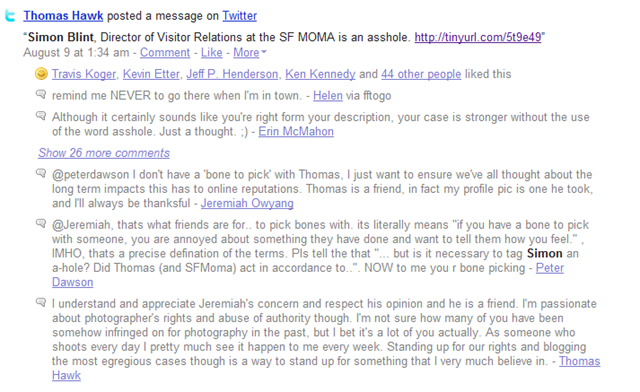
Two incidents this week, both well publicised on Friendfeed illustrate the power of the social network.
The first, and arguably most public, is the PR battle now erupting between Thomas Hawk (the photographer) and his supporters on the one side, and the San Francisco Museum of Modern Art on the other. In the middle there are a few moderates keeping a steady and cool head.
After purchasing my family membership and visiting the museum today I was forcibly thrown out of the museum by two museum security guards at the direction of the Director of Visitor Relations Simon Blint.
My crime? Taking a photograph from the second floor stairs in the SFMOMA’s atrium (an area where the SF MOMA’s own website explicitly says photography is allowed).
And again ( the following day):
One allegation that has been raised is that Blint threw me out because he felt that I was shooting down a low cut blouse of one of his employees sitting in the atrium below where I was shooting. The photo above is a photo that I snapped of Blint as he was publicly admonishing me from the floor, that’s him with his arms crossed there — he’s about the size of an ant in the photo.

I can vouch for the absurdity of shooting down a low cut blouse with 14mm lens from the top of those stairs
The comments are prolific on both these posts with a number of differing viewpoints about Thomas’ account. While most are not explicitly for or against, there is a searach for a middle ground between emphasising Photographers Rights and the way in which the situation was handled. Just do a search for “Simon Blint” on Friendfeed. Here.
SFMOMA responded with this Press Release:
Last Friday an incident occurred in our museum in which a visitor was asked to leave the building. We stand firmly behind the actions of our director of visitor services, who acted appropriately to ensure the safety of the museum’s admissions staff. He took measures to protect another staff member who according to witnesses on our staff and among the general public was being photographed in an inappropriate and harassing manner. SFMOMA welcomes over 600,000 visitors annually; disputes and disagreements between our guests and our staff very rarely occur.
This was not an issue relating to the museum’s official photography policy. In fact, SFMOMA recently made a policy change to allow photographers to take pictures of the permanent collection, the architecture of the building, and the museum’s public spaces.
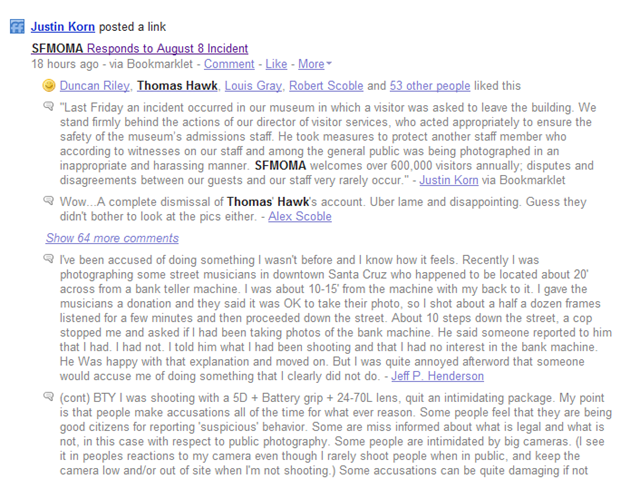
The comments on this link on Friendfeed are quite interesting, you can find them here. Most are wondering why the other side of the story is not being told here (Since all the information we have is from Thomas). I can understadn them drawing a line under the incident. I’d want to as well: the issue of Photographers rights has well and truly been highlighted.
This whole discussion has gotten way out of hand. Someone even posted a link to Simon Blints Facebook page ( Which I will not link to, on principle). On the one hand, this will dominate any Google searches for Simon and potentially portray him in the wrong light. On the other it portrays him as on his toes, looking out for the needs of his employees and visitors alike (tenuous, I know, but still).
Do I think Thomas should have blogged this? Yes indeed. Do I think both sides could have handled it better. Yes again.
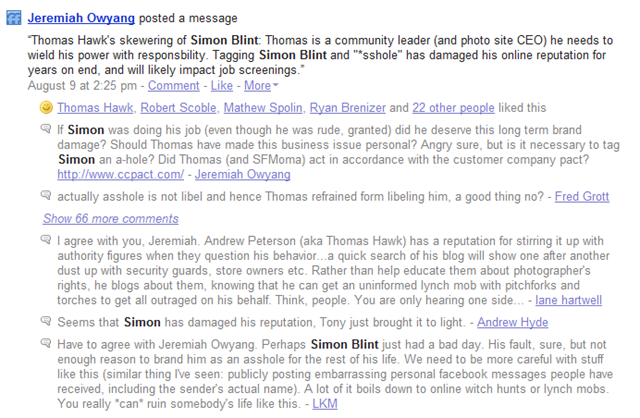
In closing, Jeremiah Owyang said the following:
Thomas Hawk’s skewering of Simon Blint: Thomas is a community leader (and photo site CEO) he needs to wield his power with responsbility
And you can see the level of discussion that generated below:
The other one, which I am less informed about is a solely a twitter affair. Usually Twitters popup in my feed entirely out of context. This time, however almost my entire page way covered in Twiters between Jason Calcanis of Mahalo and Andrew Baron.
And boy were the insults flying back and forth.
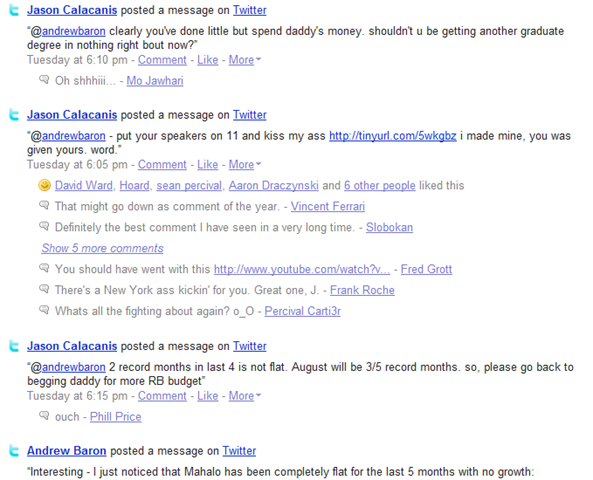
It takes up the first page and a half of this FF search.
That last entry in the picture above refers to this chart regarding Mahalo traffic numbers:
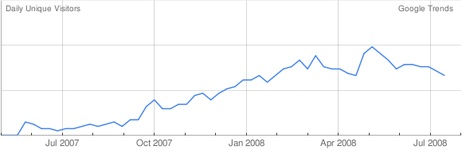
And that’s how this whole thing kicked off. Exactly what was the bone of contention, I’ve no idea.
Again, the power of social networks was leveraged since the combined communities of Twitter and Friendfeed were spectators to the whole debacle. What ordinarily would be solved via email just a few years ago, now is thrust on to the Internet for all to see.
What is particularly troublesome of this kind of behaviour across multiple social networks is the effect that they have. No matter who was in the right or wrong, it leaves a bad taste in my mouth.
These two incidents also shows the difference in format between two highly successful social networks (can you even describe FF as a social network?). It emphasises that we can either interact with the content or which each other. Interacting with the content gives us a starting pint for conversation, interacting with each other, apparently, can be much shakier.
Of the two choices, I would rather join a discussion centring on something solid, a blog post, link, photo or even an informative twitter.
 Random Musings