On Robotic Fish

I was reading this weeks New Scientist ( the print edition, mind you) and this story  about what the US Navy’s Office of Naval Research is doing caught my eye:

AGILE robotic fish that look like the real thing are being developed to act as government spies.

The article goes onto say that the fish will have cameras and communicate with each other using sonar.

To anyone that has read Michael Crichton’s Prey, this sounds suspiciously like a multi-agent system, albeit one that uses physical agents rather than computer simulated ones.

Wikipeedia has this to say:

The exact nature of the agents is a matter of some controversy. They are sometimes claimed to be autonomous. For example a household floor cleaning robot can be autonomous in that it is dependent on a human operator only to start it up. On the other hand, in practice, all agents are under active human supervision. Furthermore, the more important the activities of the agent are to humans, the more supervision that they receive. In fact, autonomy is seldom desired. Instead interdependent systems are needed.

[…]

MAS systems are also referred to as “self-organized systems” as they tend to find the best solution for their problems “without intervention”.

[…]

The main feature which is achieved when developing MAS systems, if they work, is flexibility, since a MAS system can be added to, modified and reconstructed, without the need for detailed rewriting of the application. These systems also tend to be rapidly self-recovering and failure proof, usually due to the heavy redundancy of components and the self managed features, referred to, above.

Although we’re not likely to see these become evolving, man-eating piranhas, it is something to keep an eye on (if you’ve read the book, you’ll know where I’m coming from).

And it demonstrates a physical application of  this technology that, while the agents are not strictly independent, they are not exactly predictable either.

At least, that is the way I understand it.

By the Way

In case everyone thinks that I’m living under a rock, at the bottom of a mine or otherwise incommunicado, I’m  letting you know that I’m, not going to put a post up every time Sun buys a company (Storagetek, MySQL, etc) or Robert Scoble changes jobs 🙂 .

Others cover it far better than I can. And you can get all that news from my Link Blog ( the most recent additions are on your right) .

Data: Mine or Theirs?

Although I’m writing this under the fallout of  Scoble-Facebook, I don’t think the issue of who owns your data is either confined only to Digital identity or has been very well thought out.

First, a roundup of the various reactions:

It’s not about data portability. It’s about trust.

Offline, my friends and I share a mutual connection. Maybe it’s around work, maybe it’s around our kids or something in our past. Whatever it is, they’re my friend because they know something about me beyond what’s easily accessible to others. Keyword here is mutual. I know a bit about them too. Their relationship with me is unique as compared to their relationship with others.

Online, those lines are blurred. For what I would guess is at least 4,500 of the 5,000 “friends” Robert Scoble has on Facebook, he is the equivalent of a magazine publisher and you are his subscriber base/audience. He says it’s mutual and that’s the beauty of the social and connected web, but he only cares about you when you put something on the table that he’s interested in. It’s not about you. Yet, he’s “sitting” right next to your real friends, getting the same information about you that you’re sharing with them. If he takes that information and abuses it, however un- or good-intentioned, it serves you both right.

Robert Scoble valued his relationship with Plaxo more than he valued his relationship with his “friends,” otherwise he would have posted to them what he was doing with an experimental, alpha-quality and untested script before he did it…or he wouldn’t have done it at all.

Judi Sohn

I think there are two questions here. The first is whether users should be able to extract their data [including social graph data] from one service and import it into another. I personally believe the answer is Yes and this philosophy underlies what we’ve been working on at Windows Live and specifically the team I’m on which is responsible for the social graph contacts platform.

Dare Obasanjo

Then there is the oft-cited  post by Paul Buchheit (the guy who created Gmail).

Now I’m not on Facebook et al for a reason: data, in the case of a person,  is that person. Whereas data for iTunes is essentially  the signals sent to your sound card. Se the difference

Is it important to guard those things? Yes, or course. At the end of the day, its all you are left with if everything goes to hell: Your sense of self and identity, and your friends ( real friends, that is).

So we essentially have two options:

  1. Manage that data ourselves in a way that gives complete and utter control over every aspect of things
  2. Give our data over to a less than trustworthy service that essentially controls who you are, your identity ( on- and off-line) and who your freinds are and what your realtionship is with them

I’ll take option one any day of the week. Why? Becuase of control. It is all about control.

Plaxo may or may not keep your data after you opt-out ( i think its the former rather than the latter). Facebook has the awesome power of wiping out very single trace of you from its universe with a simple mouse-click. Add a hundred and one other web services that suck your data out of Google, Hotmail and the like.

There is a missing element in the above situations. Find it yet? And its not trust. Its control. And I mean, complete and utter control.

At least Twitter gives you more granular control( in terms of message recipients)  and has a proper API.

Better yet, Open ID, while somewhat flawed, is a brilliant idea insofar as you have a digital identity provided and vouchsafed by a trusted source ( AOL, for example). This blog is my digital identity ( since WP supports Open ID).  I can decide what to do with that identity, what to reveal, what to password protect. If I move on to from one blog to another, I can export all my posts and import them else where.

In short I have complete control of that Open ID identity (short of running my own webserver).

So because I have control I can never be in a Scoble snafu like that ( And I don’t care for the fact that Scoble was pressing FB’s buttons on purpose – he gave up his control over that data and he knew it).

In a  sense, its the MS DOS command line all over again. And  loss of control is like letting Vista hide the RUN command and the task manager and tickle itself silly with crashes.

FSJ Redeems Himself (a la Twitter)

After “PodtechGate” ( see this, this, this and this). With this:

TWITTER UPDATE: This just in from Scoble’s Twitter feed. PodTech receiving an investment from unnamed large industry player at a $20 billion valuation. Bubble be damned!
TWITTER UPDATE: Scoble denying on Twitter the rumors of investment at $20 billion valuation.
TWITTER UPDATE: Scoble now in his car, talking on iPhone about $20 billion rumor.
TWITTER UPDATE: Scoble now off iPhone, thinking about $20 billion valuation.
TWITTER UPDATE: Scoble believing it may actually be true.
TWITTER UPDATE: Scoble stopped at red light.
TWITTER UPDATE: Scoble making right on red.
TWITTER UPDATE: Scoble thinking about coffee.
TWITTER UPDATE: Scoble in Starbucks.
TWITTER UPDATE: Scoble tells barista PodTech now worth $20 billion. Offers to pay for coffee with a share of Podtech stock. Barista declines.
TWITTER UPDATE: Scoble on phone to Google, asking for Sergey.
TWITTER UPDATE: Scoble on hold.
TWITTER UPDATE: Scoble realizes line is dead.
TWITTER UPDATE: Scoble redialing. Willing to settle for $15 billion.

Multi- Gigabyte File Copy Operations

Copying more than one gigabyte in one operation is tedious, frustrating and agonizingly slow. Not that there is all that much you can do.

Scott Allen was having a little bit of difficulty so I’ thought I’d help a little.

Scott Hansellman has a post on 3 utilities you can use to copy files without using the windows explorer.

First, Robocopy. If you have XP or Windows Server you can easily get this in the Resource Kits. If you have Vista, it’s already in your path. That’s always nice. It’s Robust, indeed (hence, Robocopy) but it’s legendarily unforgiving

Second, for repeatable jobs, I love SyncBackSE. It’s $30, but there is a free version with less features available. SyncBack is option-ful and literally moves nearly every important piece of data in my house around weekly.

Last, but certainly not least, XXCOPY. It’s huge. Epic even. It’s even got a nice windows progress bar that pops out of the DOS Box. The Technical Reference is comprehensive to say the least. Here’s a summary of the features. It’ll sync directories, maintain short names, qualify by date/time, copy security info.

I’ve used Robocopy. The GUI frontend is next to useless (either that, or I’m doing something wrong).

I’ve yet to try the other two.

Hope this helps someone.

Cheering up the Original iPhone Owners

Fake Steve Jobs made me laugh out loud:

Well, we’ve got a plan to restore some of that magic you felt on Day One. No, not a $200 rebate. And no, we’re not going to let you return the phone or cancel your plan with AT&T. But here’s what we’re going to do. It’s a sticker. Bring in your receipt to any Apple store or AT&T store and show that you paid full price for your iPhone, and we’ll give you a sticker that says, “Original iPhone.” Very small, very classy, black on black, made of super high quality plastic with a glossy finish. Something you’ll be proud to put on your iPhone so everyone will know that you’re not just any iPhone user; you’re one of the super smart, super cool early adopters who paid full price. You see? We’ve got you covered. I know what you want to tell me. What can I say? You’re welcome. I love you too. And you are special. I mean it.

One problem. They’re not buying it. They’re stalking el Jobso:

Damn. Last night they were out there holding a candlelight vigil and singing “We Shall Overcome.” To hell with it. I’m calling the police.

Thinking about Facebook

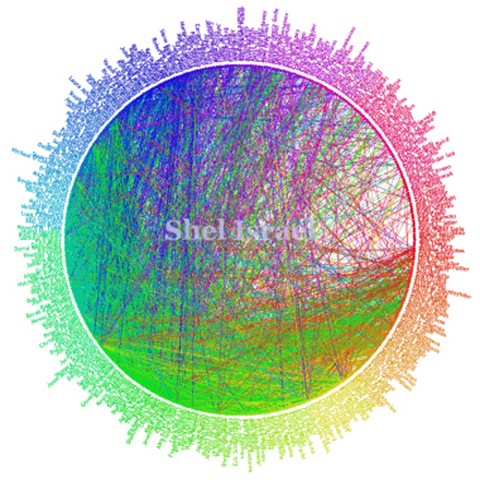
1279612562_037da79269

Above is Shel Isreal’s Friendwheel of his Facebook Contacts . In the interests of disclosure, I’m not on it. In fact I’m not even on Facebook. And I’m exploring why in this post.

The above picture shows a true social network, pardon the term for a minute. Most people who know Shel know others in his contact list as well.

There are a few hundred contacts here, and it is a reasonable number of people to know and be in contact with. See the difference between being like Scoble who has 5000 people who happen to read his blog and having a shortlist of  “real” people that you know personally and do business with?

If you sit down and consider this for a moment, you’ll see the logic of that statement. We all have  lists of contacts, in Outlook, Messenger, in our Mobile Phones or perhaps written in a phonebook. They are there because we know these people personally and communicate with them often.

Now I would not have the email address and phone number of my readers ( assuming I have regulars who read my blog) on my mobile in Messenger or in Outlook ( actually Google Mail, now).

Why should it be any different on FaceBook???? Why do people add contacts that they’ve never met in person?

 (And Scoble, by the very nature of his work, needs to keep a pulse on the Valley – thus his large contact list. I was just using him as an example)

Now I DO concede the point that this is exactly what happens in business – people exchange cards on a whim in the hope of acquiring business or services from someone else.

Which leads us to the next question? What do you characterize Facebook as? Is Shel’s Facebook Contacts made up mostly of froends, ore mostly of people in the same line of work ( I guess its the latter)? In other words, is Facebook a social of a business contact site?

I ask since Facebook was originally a students only site.

So why am I not on Facebook? Simple. I don’t need to be.

PS. I addition to the above, where does Facebook add value? If its business-oriented how does it do this? If its Socially-oriented, how?