Hard Drive Troubles

image

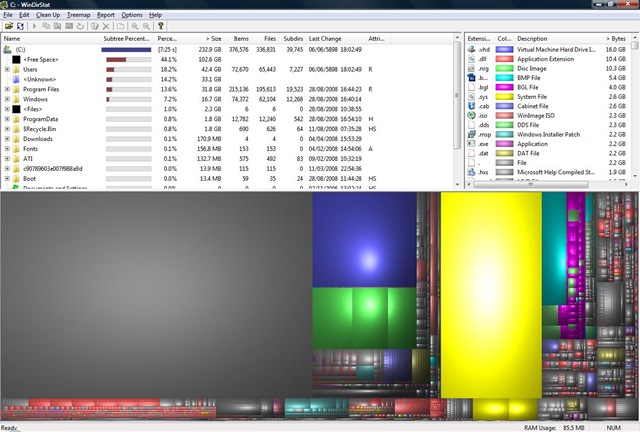
This picture was taken using WinDirStat to image the drive. Great utility, by the way. Its part of my Software Keychain now.

See that yellow area over there? Its 3.5Gbs of space that are used, but not accessible via Exploder and thus the Windows API.

Before you ask, I already tried RootkitRevealer from SysInternals, but it doesn’t work on Vista.

It was 63Gbs yesterday. Here’s what I did:

Then I decided that if I restore from a Windows Home Server backup, the unknown space shouldn’t be there as its effectively invisible to the Backup service at the time of making a backup.

Which I did. After booting up, it didn’t work.

However, this morning chkdsk started as part of the boot sequence, no idea why. And the hole in my hard drive is gone  reduced.

Whew. I was contemplating a complete rebuild of my laptop.

Out of curiosity I ran WinDirStat on my Desktop.

Here’s what I got:

desktopwindirstat

Again, there’s a 30Gb hole in the hard drive.

I ran chkdsk.exe and got a slightly tidier picture, but with the 30Gb hole still there.

Looks like I’m going to have to restore it from WHS as well.

Social Networks at Work

IF you’re surprised that I’ve gone so long without posting here properly, its because I’ve been spending so much time on Friendfeed.

Friendfeed suits my style so much better than blogging. With its link/article centred comments threads, it allows short comments about a particular subject that aren’t a blog in length. Its suits my free ranging style, commenting of just about anything that I’m interested in.

Two incidents this week, both well publicised on Friendfeed illustrate the power of the social network.

The first, and arguably most public, is the PR battle now erupting between Thomas Hawk (the photographer) and his supporters on the one side, and the San Francisco Museum of Modern Art on the other. In the middle there are a few moderates keeping a steady and cool head.

Thomas Hawk:

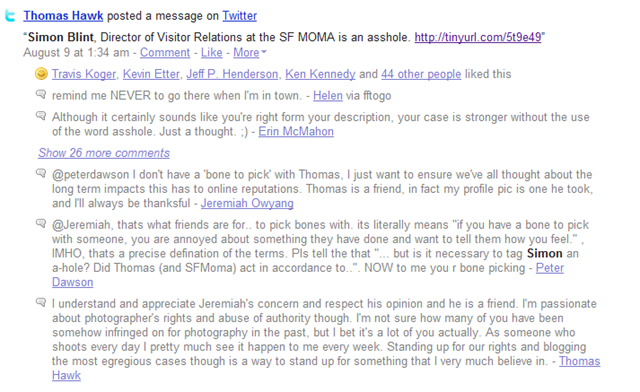
After purchasing my family membership and visiting the museum today I was forcibly thrown out of the museum by two museum security guards at the direction of the Director of Visitor Relations Simon Blint.
My crime? Taking a photograph from the second floor stairs in the SFMOMA’s atrium (an area where the SF MOMA’s own website explicitly says photography is allowed).
image

And again ( the following day):

One allegation that has been raised is that Blint threw me out because he felt that I was shooting down a low cut blouse of one of his employees sitting in the atrium below where I was shooting. The photo above is a photo that I snapped of Blint as he was publicly admonishing me from the floor, that’s him with his arms crossed there — he’s about the size of an ant in the photo.
image

I can vouch for the absurdity of shooting down a low cut blouse with  14mm lens from the top of those stairs

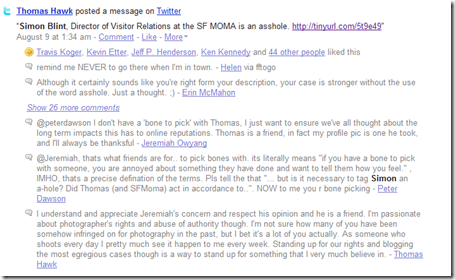
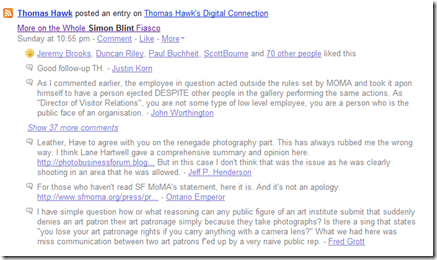
The comments are prolific on both these posts with a number of differing viewpoints about Thomas’ account. While most are not explicitly for or against, there is a searach for a middle ground between emphasising Photographers Rights and the way in which the situation was handled. Just do a search for “Simon Blint” on Friendfeed. Here.

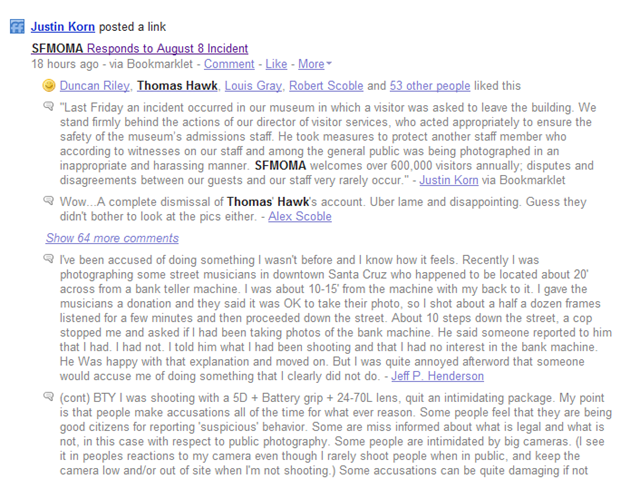
SFMOMA responded with this Press Release:

Last Friday an incident occurred in our museum in which a visitor was asked to leave the building. We stand firmly behind the actions of our director of visitor services, who acted appropriately to ensure the safety of the museum’s admissions staff. He took measures to protect another staff member who according to witnesses on our staff and among the general public was being photographed in an inappropriate and harassing manner. SFMOMA welcomes over 600,000 visitors annually; disputes and disagreements between our guests and our staff very rarely occur.
This was not an issue relating to the museum’s official photography policy. In fact, SFMOMA recently made a policy change to allow photographers to take pictures of the permanent collection, the architecture of the building, and the museum’s public spaces.

image

The comments on this link on Friendfeed are quite interesting, you can find them here. Most are wondering why the other side of the story is not being told here (Since all the information we have is from Thomas). I can understadn them drawing a line under the incident. I’d want to as well:  the issue of Photographers rights has well and truly been highlighted.

This whole discussion has gotten way out of hand. Someone even posted a link to Simon Blints Facebook page ( Which I will not link to, on principle). On the one hand, this will dominate any Google searches for Simon and potentially portray him in the wrong light. On the other it portrays him as on his toes, looking out for the needs of his employees and visitors alike (tenuous, I know, but still).

Do I think Thomas should have blogged this? Yes indeed. Do I think both sides could have handled it better. Yes again.

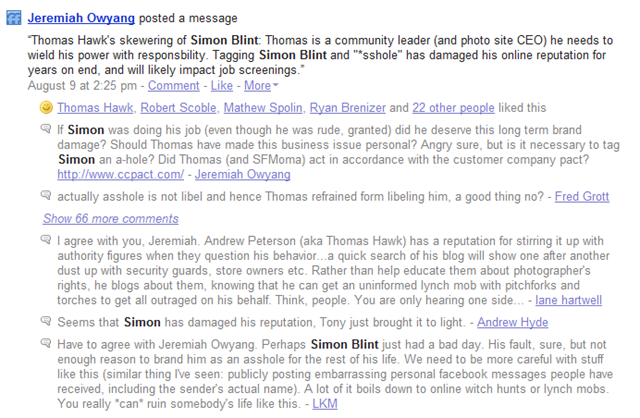
In closing, Jeremiah Owyang said the following:

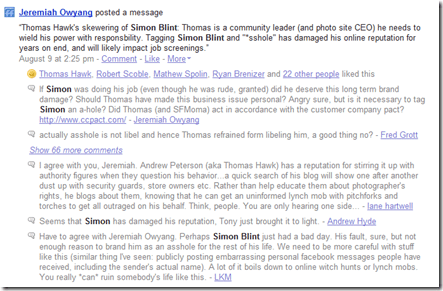
Thomas Hawk’s skewering of Simon Blint: Thomas is a community leader (and photo site CEO) he needs to wield his power with responsbility

And you can see the level of discussion that generated below:
image 

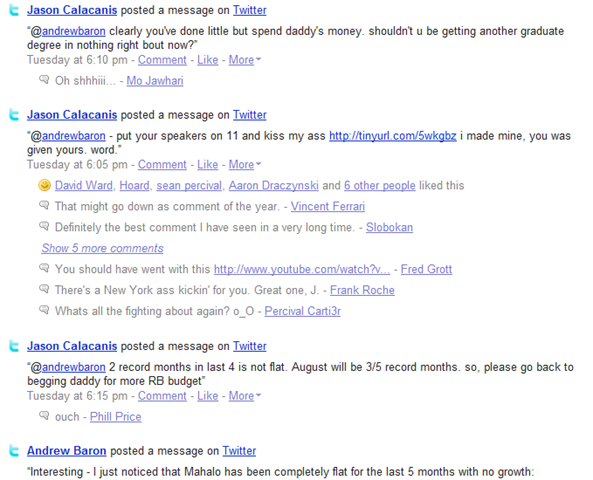
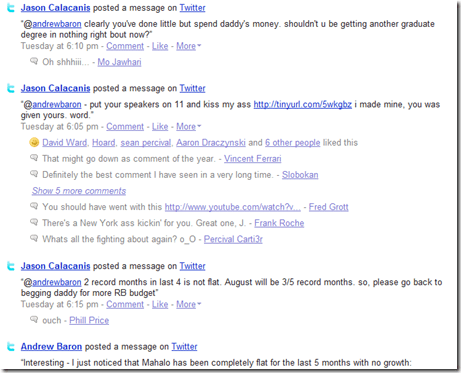
The other one, which I am less informed about is a solely a twitter affair. Usually Twitters popup in my feed entirely out of context. This time, however almost my entire page way covered in Twiters between Jason Calcanis of Mahalo and Andrew Baron.

And boy were the insults flying back and forth.
image

It takes up the first page and a half of this FF search.

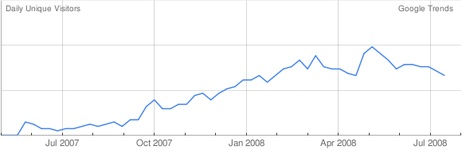
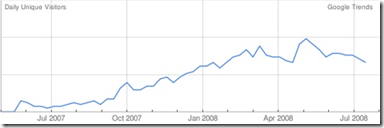
That last entry in the picture above refers to this chart regarding Mahalo traffic numbers:
image

And that’s how this whole thing kicked off. Exactly what was the bone of contention, I’ve no idea.

Again, the power of social networks was leveraged since the combined communities of Twitter and Friendfeed were spectators to the whole debacle.  What ordinarily would be solved via email just a few years ago, now is thrust on to the Internet for all to see.

What is particularly troublesome of this kind of behaviour across multiple social networks is the effect that they have. No matter who was in the right or wrong, it leaves a bad taste in my mouth.

These two incidents also shows the difference in format between two highly successful social networks (can you even describe FF as a social network?). It emphasises that we can either interact with the content or which each other. Interacting with the content gives us a starting pint for conversation, interacting with each other, apparently, can be much shakier.

Of the two choices, I would rather join a discussion centring on something solid, a blog post, link, photo or even an informative twitter.

As the World Turns – Social Median, Cuil, Knol

Its quite interesting that the Internet continues to spawn new incarnations of social networks and search engines.

One question: Why?

I think is got to do with the fact that we all perceive things differently. Twitter and FreindFeed is the perfect example of this. I’m on FriendFeed (excuse the extra hype) but not on Twitter. This is because FreindFeed is the kind of social network I can use. Twitters central axiom of “What are you Doing?” is very different to FreindFeed’s approach whereby we share things. I’m more comfortable with the thought of having something more concrete to talk about and comment on.

In like manner, there are a Billion people on the Internet today and there is not going to be a one size fits all solution to the way people want to interact with each other. There might as well be as many social networks as there are people. Consider that Flikr and  SmugMug are social networks in themselves, yet they use photographs as a catalyst for conversation. So this illustrates my points about different approaches to the social interaction that people crave.

This weeks entry into the Social network race was SocialMedian. I have not tried it myself anad reviews seems to be mixed. We will see what happens.

Search is another area that people use based on how comfortable. I’m a Google user at the moment. yet there is Windows Live Search, Yahoo and now Cuil, a new take on the search engine by former Googlers. Its presentation of results in a magazine format is instantly recognizable to readers of print publications. Its presentation of possibly related information- for example I searched for myself and got my blog posts as a expected, but also a list of Italian football players – is very well done as well.

So my point is that even for something as simple as search, people have different perceptions and there will always be ways to improve to better meet users expectations.

Google Knol, and I’m mentioning it in passing is an attempt to upset Wikipedia’s cup. A Knol is supposed to be a unit of knowledge. And I’m sure you can see where this is going. And remember that not everything Google comes up with is an instant hit. It will probably be in perpetual beta for a while. So don’t write it off just yet.

Will there be an end to this? Its possible that some form of consolidation will take place if these startups, and others, take off. After all, the big players will continue to want to improve their offerings and some of the radical ideas now days come out of the startups rather than the established companies.

iPods, Touch Screens and the Future

With the release of the 2.0 software update for the Touch, Apple has made a mockery of every smartphone on the market as well as the DS and the PSP.

Short of an iPhone, it is quite simply the indispensable gadget to have on you at all times.

I have no Exchange servers to connect to and haven’t tried MobileMe. But I have been in the App Store. And boy, have been buying.

I’m a Crash Bandicoot fan from the dark old days of the PS1, so the first game I got was Crash Bandicoot Nitro Kart Racing 3D. And it does not disappoint. The tilt controllers make it a compelling game, as well as a challenging one. And one you will strive to master. Just play it standing still as the tilt sensors are sensitive. 

iPint is hilarious. For a free app its brilliant. I’ve been generating laughs with it all weekend.

I installed DutchTab as well. Thought I’d get a chance to use it over the weekend, but it didn’t present itself. Calculating how to split the tab is difficult so I usually don’t bother, just leave an unusually large tip. This should change that.

However, not all the applications in App Store are iTouch compatible. GPS and Camera apps naturally will only work on an iPhone.

This makes the iPhone 3G a really compelling device to get.

There has been lots of discussion over on FriendFeed about how this changes the nature of personal computing ( see here, here and here for a selection). The basic idea is that it changes personal computing in a big way.

I’d also say that the idea of ubiquitous computing comes closer as well. With a device like the iPod Touch and the iPhone, we take computing power where ever we need it – it seamlessly integrates with our lives. We take the web with us as well, fulfilling the dream of constantly connected devices. Push email is not  a new idea – Blackberry owners have had it for years. But Apple had taken it to a whole new level. Using the touch screen, ur interactions with our devices become so much more natural and compelling. A keyboard and mouse reminds you of what you are using, a touch screen uses the human mediums of touch, feel and gestures to communicate.

This is where computing is going in the next few years. I prefer using my Touch for web browsing because of the touch screen – its feels more natural. Windows & will have touch screen built in, and Microsoft Surface is already capitalising on the naturalness of the touch screen to re-definite the way we interact with computers – and redefine computers themselves.

As science fiction writer William Gibson said:

The future is here. It’s just not evenly distributed yet

FriendFeed as a Service

I’m on holiday and just logged on to FriendFeed after a week away.

What I found was a load of Twitter comments that make no sense outside of their conversation context and two items of interest (Why Twitter is better than FriendFeed – which makes little sense and Internet-savvy voters shake up US presidential election which does).

The point being that on any particular day one’s  noise filter varies – in this case I wish to be rid of Twitters because I’m out of time (I’m being charged for WiFi – Net Neutrality for you!!).

Second, the interestingness ( yes, Yahoo I’m infringing on your patent) of the items is arbitrary. Thus what appeals to me one day may be the next based on my current circumstances ( this time I’m in a hurry and a summary would be best). In this second point, FF has done very well, giving Best Of filters for the Day, Week and Month ( through one could argue for the value of a Year filter). The Weekly best of gives me this item that springs to my attention:

Steve Rubel: “I am working on a post about the implication of Friendfeed, Mahalo and other human discovery engines on PR and journalism. Interested in your thoughts please share. ”

There’s  fascinating discussion in the comments. Its rather noticeable that items with lots of Likes and Comments appear in this filter.

Buts its my first point that needs to be addressed: I want to temporarily blog twitters, for example when I’m busy. Its noise control for when its needed.

But don’t get me wrong – I like the noise.

Online Aggregation – a la FriendFeed

If you read regularly, you’ve probably begun to wonder where i’ve been these past few weeks. I’m not blaming you.

Between FriendFeed and exams there aren’t enough hours in the day.

FreindFeed itself is great. Being able to aggregate so much data in one place is very useful. FF ( as FriendFeed is shortened to) supports 35 ( or more) services directly and more through the use of the RSS feed(s) that you can add.

Robert Scoble is the prime example of this. The sheer amount of online output the man generates makes you wonder if he ever sleeps.  Go on, click the link and admire this river of news, posts, tweets, videos and photos. Then take a look at how many friends the guys has- well over 10,000 people as friends ( people that either are subscribed to him or he subscribes to). FF has a Friend of a Friend feature that add some of his friends posts to your home page on FF. This gives you a tremendous amount of noise to wade through.

And combine this with all your other friends. This gives you a long, long river of news to read through.

However, FF is not a true social networking site. It aggregates data from a huge amount of sites. But your Friends are nothing more than people you’ve subscribed to for their feed. Its rather like saying that because you have a subscription to the NYT you are their friend and they’re yours.

To reinforce the point there is zero information about you save a picture – which suits me as you’ll notice I don’t have an About Me page ( I’m thinking about putting one up, though). And I’m dithering on what picture I should put up.

Jennifer Woodward Maderazo made the point that its very personal having all this information in one place. Possibly. It depends on what information you share. Robert Scoble and Thomas Hawk have no problem with this – they’re subscribed to practically every service available. I mean, its darn interesting to see what photos Thomas favourites on Flickr. I’m sure its possible to figure out his taste in photos and his political leanings from his content. Even how he likes Mac and  Microsoft solely for its Windows Media Centre.  But there is no real, personal  information being shared here.

On Jennifer’s second point about no real interaction – come on!! I comment more in FF than outside, often commenting as a post comes in, and as part of a conversation. I like a lot as well ( comments and likes are another way if discerning peoples taste – but no real information is there. See above). If there is anything to suggest its no otherwise the case, its that comments don’t follow items as they are ReShared or posted within FF. This inevitably leads to fragmented conversations and a reduction in interaction. Also blog and FF comments should be synced in some form that will lead to even more interaction.

And Jennifer’s last point about information overload is just plain wrong. We have fine grained control of what turns up in our feed. from hiding friends of friends completely to hiding on a per-friend-per-service basis ( you can also blanket hide a service entirely – so no Twitter tweets show up from any friend, ever).

The Flickr favourites feature I mentioned above is a compelling reason to join Flickr ( I’m with SmugMug and intend to stay – you’ll see my photos show up).

One thing that is surprising is that FF is slowing taking attention share away from Google Reader. Not just when it comes to commenting, but I post links that I find interesting. Steve Rubel, for example, tweets and posts links fairly often that point to interesting material – I share some. But those don’t show up in my Shared items to your right ( from Google Reader Shared items). I’m thinking of some way to integrate them together using the FF API.

Another reason is the Imaginary Friend feature. I currently only have one at the moment – MarsPhoenix. If that sounds familiar to you its that lander NASA just put on Mars’ north pole. Its got two blogs and a twitter feed. This Friend combines them into a one feed with posts from both blogs mixed in with the numerous tweet updates and makes it dead easy to follow via FF or RSS. These appear as fart of my feed on the FF homepage along with everything else, making it doubly useful.

FF is literally Google Reader gone wild (rather than Twitter). Its subscriptions based. And, one up on Google Reader, shares all of your online activity back to the community. Its not even Digg (I can’t remember the last time I logged in to Digg).

Many belive that Robert will be going on about another service in a few months time. But FF has the traction ( its many services and thus audiences that it serves) and the leverage (the huge number of adopters it has at the moment) to survive. It straddles the difference between a true, thoroughbred networking site like Twitter ( or Facebook, if you prefer) and the disconnected consumption of content of a RSS reader. Its perfectly situated to bridge the gap between all these disparate services.

Quote of the Day

Echoes’ outlines Microsoft’s biggest challenges: the inordinate amount of time they spend on developing products that are either a platform or a suite forces them to make too many compromises. One can’t blame the company whose DNA is Windows (Platform) & a Suite (Office.) This is a malady which makes them unable to move ahead and define the future.

Om Malik

Normal posting resumes shortly.

Link of the Day

via Scott Rosenburg:

Pentagon’s Accounting Mess – Portfolio.com: Yet Another Federal Software Quagmire (cf. the IRS, the FBI, the FAA, etc.). An account of the Pentagon’s failure to upgrade its ancient mainframe-era accounting system; the tale unfolds in a building in Indianapolis the size of 28 football fields, and explains why the U.S. military cannot be audited. The Pentagon literally cannot tell you how much it has spent or what it has purchased. If you ran your family this way, they’d disown you.

Err, this is the 21st Century and this should not be too difficult to accomplish.

And they’re still using COBOL?? What can I say?

<humour> Solution? Call Microsoft </humour>

Subversion Source Control

This post has been bouncing around my head for sometime since finding the time to write has been a little hard.

The fact is that the whole Subversion vs Git vs TFS vs [insert preferred system here] debate can get to the point where its quasi-religious (as are numerous other tech debates – windows vs mac being one of the notable ones).

Now I, bad developer that I am, have only recently started using Subversion. The need to sync source code between my desktop and my laptop outgrew the copy/paste via Windows Home Server share approach.

The fact that Subversion is free is also a big deal maker ( compared to, say Team Foundation Server).

I have been using it on another free product, namely Netbeans 6.01 for my Java development. Its nothing major, only university projects. 

The fact is that Netbeans comes with Subversion and CVN support baked into the IDE. Additionally, Netbeans uses its own Local History feature to keep track of your files wether you’re using formal source control or not. Every time you build your project it makes a commit to your Local History. This means that one has both Local history for the small changes and Subversion for the big changes.

The fact is that having it baked into the IDE makes all the difference – it allows one to interact with the code in revisions directly. Let me explain. One can make line-by-line rollbacks from your previous versions wether you are using Local history or Subversion or both. Powerfully, the rollbacks count as changes to your code and are committed right back to the database.

(I plan to do a post on the value of a good IDE soon as well)

image

In the (Subversion) case above, the local copy is out of date (on the right) and the remote changes (on the left) are shown in blue. The changes were made on my laptop, committed and I’m comparing them against the desktop copy of the files.

By clicking on the blue arrow one can insert the changes into the local copy with out inserting all the changes. The same applies for replacements (in cases where the lines have been modified rather than outright replaced).

The green area in the local copy no longer exists and by clicking on the red cross one can delete the highlighted lines.

Local History works in exactly the same way.

This is a small example and one needs to actually use it to understand the power of the concept.

Now, the fact is that the vast majority of my coding gets done in Visual Studio. And Visual Studio , the TFS edition aside, does not support source control. Period.

However, VisualSVN actually has an Add-In for Visual Studio that brings this functionality into the IDE. The problem is  that the Add-In isn’t free. Its $49 per licence. Personal licenses are restricted to one per order ( but not corporate licenses) and open source projects qualify for free licenses. And, no, I haven’t yet decided whether to get a license.

I agree with Jeff Atwood that software such as Firefox should take the most popular Add-Ins and fold them in the main code base. Which gives rise to the question that if Source Control is so important and popular (is it for non-TFS Visual Studio users????), why doesn’t Microsoft add it in?

I mean its only Subversion. Surely Microsoft must have some pretty good selling points related to why TFS is, like, totally better than Subversion ( 😉 ). That takes care of the “They already have source control” pundits.

Source Control is simply good programming practice and if Microsoft is serious about attracting people to its platform (and the freely available express editions shows that they are somewhat serious), they should provide it.

Contrast Visual Studio to Netbeans and that’s enough said on the subject.

Now the easiest way to install Subversion is to head over to Jeff’s blog post about it. If you don’t subscribe to Jeff’s blog, i suggest that you do – its invaluable.

I went the VisualSVN server route which set everything up with the addition of  the ability to browse the server using a web browser (it does this by using Apache). To avoid Apache conflicting with Windows Home Server, its running on a Virtual Server virtual machine ( that image runs a few other odds and ends). Setting up Virtual Server on WHS is itself the subject of another blog post. It took me literally 2 minutes.

Before letting you go, Scott Hanselman has a great podcast on Subversion vs Git for Source Control and it comes highly recommended.