Google’s Chrome

Google today launched a new browser, called Chrome.

And you can get it from www.google.com/chrome

Its lightweight, refreshing and has a few nice features I’ve been looking for Mozilla to implement in FF. Namely that you can move tabs between windows. And it has a spellchecker built in (I’m too lazy to install THAT FF plugin). And a privacy mode ( why on earth one would want to use it is beyond me). And its based on Webkit, like Safari.

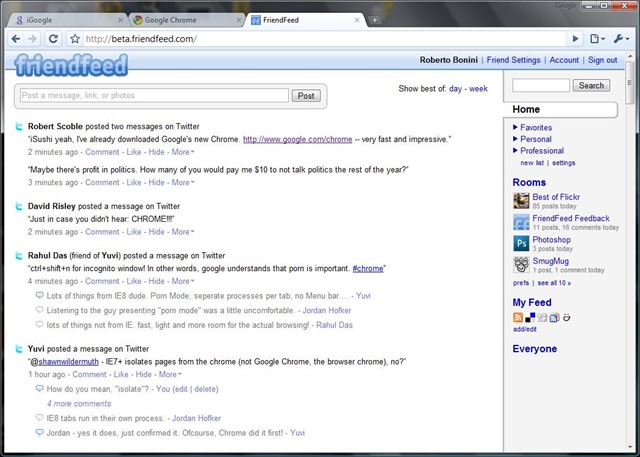
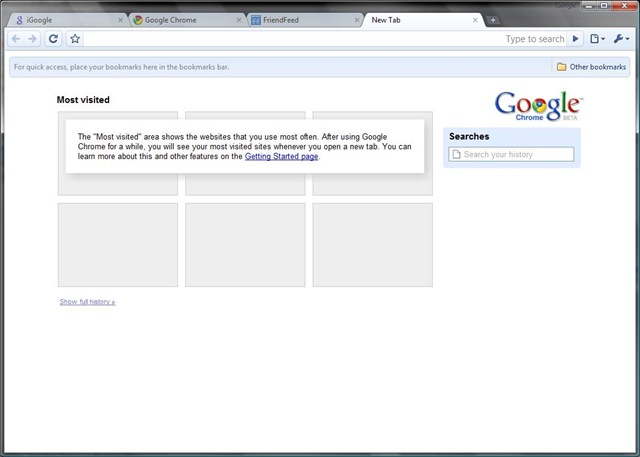
Some screenshots:

chrome 1 

chrome 2

chrome 3

Now thats as far as I’ve got with using the new browser.

Its already good enough for me to consider making it my default browser.

The Friendfeed bookmarklet works (although it detects that I’m using Safari).

There is no Delicious plugin yet (critical to me I can’t imagine not having it).

And Firebug would be nice as well – it would make developing with yet another browser slightly easier.

Robert Scoble has reported over on friendfeed that Google properties appear to be faster on Chrome ( not sure abut that yet).

And Yuvi, of statbot.com, reports that some Sliverlight apps load, but the heavy ones hang.

I’m betting that Microsoft offices are a touch louder than usual.

Lets see what happens here.

Hard Drive Troubles

image

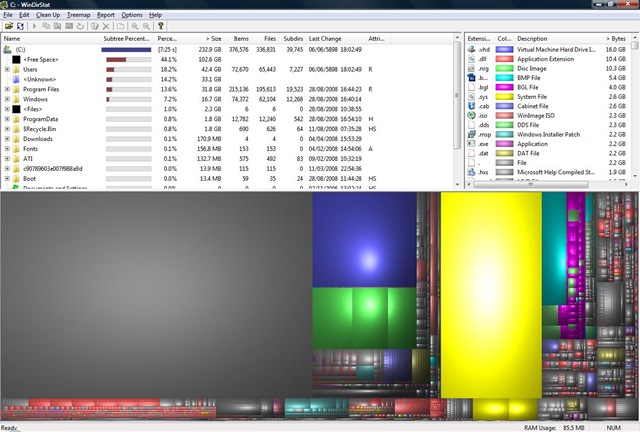
This picture was taken using WinDirStat to image the drive. Great utility, by the way. Its part of my Software Keychain now.

See that yellow area over there? Its 3.5Gbs of space that are used, but not accessible via Exploder and thus the Windows API.

Before you ask, I already tried RootkitRevealer from SysInternals, but it doesn’t work on Vista.

It was 63Gbs yesterday. Here’s what I did:

Then I decided that if I restore from a Windows Home Server backup, the unknown space shouldn’t be there as its effectively invisible to the Backup service at the time of making a backup.

Which I did. After booting up, it didn’t work.

However, this morning chkdsk started as part of the boot sequence, no idea why. And the hole in my hard drive is gone  reduced.

Whew. I was contemplating a complete rebuild of my laptop.

Out of curiosity I ran WinDirStat on my Desktop.

Here’s what I got:

desktopwindirstat

Again, there’s a 30Gb hole in the hard drive.

I ran chkdsk.exe and got a slightly tidier picture, but with the 30Gb hole still there.

Looks like I’m going to have to restore it from WHS as well.

iPods, Touch Screens and the Future

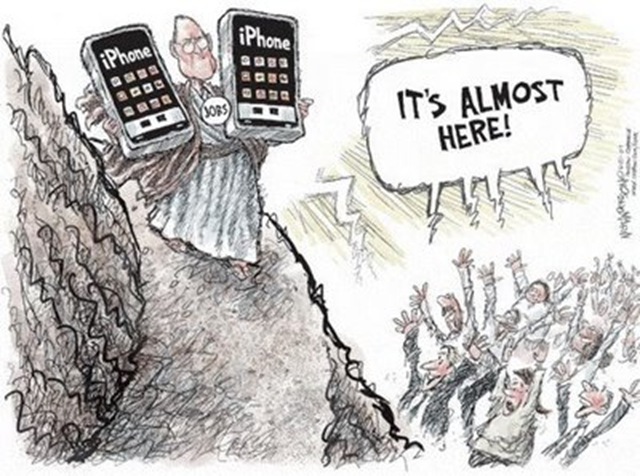
With the release of the 2.0 software update for the Touch, Apple has made a mockery of every smartphone on the market as well as the DS and the PSP.

Short of an iPhone, it is quite simply the indispensable gadget to have on you at all times.

I have no Exchange servers to connect to and haven’t tried MobileMe. But I have been in the App Store. And boy, have been buying.

I’m a Crash Bandicoot fan from the dark old days of the PS1, so the first game I got was Crash Bandicoot Nitro Kart Racing 3D. And it does not disappoint. The tilt controllers make it a compelling game, as well as a challenging one. And one you will strive to master. Just play it standing still as the tilt sensors are sensitive. 

iPint is hilarious. For a free app its brilliant. I’ve been generating laughs with it all weekend.

I installed DutchTab as well. Thought I’d get a chance to use it over the weekend, but it didn’t present itself. Calculating how to split the tab is difficult so I usually don’t bother, just leave an unusually large tip. This should change that.

However, not all the applications in App Store are iTouch compatible. GPS and Camera apps naturally will only work on an iPhone.

This makes the iPhone 3G a really compelling device to get.

There has been lots of discussion over on FriendFeed about how this changes the nature of personal computing ( see here, here and here for a selection). The basic idea is that it changes personal computing in a big way.

I’d also say that the idea of ubiquitous computing comes closer as well. With a device like the iPod Touch and the iPhone, we take computing power where ever we need it – it seamlessly integrates with our lives. We take the web with us as well, fulfilling the dream of constantly connected devices. Push email is not  a new idea – Blackberry owners have had it for years. But Apple had taken it to a whole new level. Using the touch screen, ur interactions with our devices become so much more natural and compelling. A keyboard and mouse reminds you of what you are using, a touch screen uses the human mediums of touch, feel and gestures to communicate.

This is where computing is going in the next few years. I prefer using my Touch for web browsing because of the touch screen – its feels more natural. Windows & will have touch screen built in, and Microsoft Surface is already capitalising on the naturalness of the touch screen to re-definite the way we interact with computers – and redefine computers themselves.

As science fiction writer William Gibson said:

The future is here. It’s just not evenly distributed yet

WHS Add-In: WHS2SmugMug – Update

I’ve neglected this project for a while mainly due to me being so busy with other stuff.

The hiatus has actually done the project good as feature creep was threatening to de-rail the thing the last time I had a look at it.

So I’ve cleaned up the requirements for the data to be stored locally. I’ve eliminated just about everything I can pull from SmugMug leaving me with a nice, clean object model to work with.

I was also struck by the fragmenting of the project into three – scheduled, service and WHS Console Add-in.

While this seems logical, it is a bit over the top. So I’m dropping the scheduled uploader and having uploads handled by the service.

Work is progressing nicely and I hope to have a working  service app soon ( if not a console add-in).

I’m now using the SmugMugAPIWrapper from Codeplex. Its MIT Licenced so WHS2SugMug will have to be too. This library is one that I can actually use without looking at the source as its built to use the current SmugMug API, so no worries there.

As with my Windows Live Writer add-in, I’ll host the project on Codeplex as soon as there is a release-ready codebase.

iTunes is Acting Up

image

Only a fraction of my music shows up as being music?????

I didn’t have any photos ( though 2 video podcasts from TWIP) on there at all.

Same on my iPod Touch.

I belive this happened on holiday when I downloaded a few podcasts and synced them. My music library is stored at home so I didn’t have the full library with me when I synced on holiday.

Is this some sort of bug???

I’ve no idea what has happened?? Syncing it does not work!!!

Should I try a restore??

FriendFeed gets my posts, Twice

I’ve noticed that there is a lag between my post being published and it showing up in FF (From Michel Arrington’s stream):


image

I’ve actually noticed that this is becoming the exception rather than the norm slowly but surely:

image

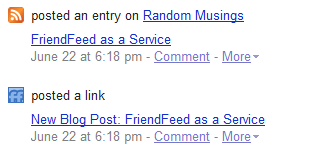
Nevertheless I wrote a plugin for Windows Live Writer that automatically posts a link to FriendFeed every time I publish a post. In fact the link in the above picture ws posted using this plugin

Since I’ve never written a WLW plugin I used the Twitter Notify plugin that is included as part of the SDK as a springboard. You might notice that there is very little code left of the original.

Since it uses the new SDK feature unavailable in WLW 2.0, you’ll need the WLW 3.0 CTP for this plugin to work.

You can get it from Codeplex here.

It will ask you for your FriendFeed username and Remote Key as well as a preamble to accompany the posted link. This is set, by default, to “Blog Post”. As you can see mine is set to “New Blog Post”. All these settings can be changed from the Plugins page of WLW options.

Suggestions are welcome as are bug fixes, etc.

The plugin is working well for me and I’ve encountered no issues, other than WLW taking slightly longer to start up ( this could be a CTP issue).

I currently thinking of:

  • Putting a link to the discussion on FF in the post( as far as I can tell this would require a re-write)
  • Linking to FF when you Update the post

Anyone else got any ideas?

FriendFeed as a Service

I’m on holiday and just logged on to FriendFeed after a week away.

What I found was a load of Twitter comments that make no sense outside of their conversation context and two items of interest (Why Twitter is better than FriendFeed – which makes little sense and Internet-savvy voters shake up US presidential election which does).

The point being that on any particular day one’s  noise filter varies – in this case I wish to be rid of Twitters because I’m out of time (I’m being charged for WiFi – Net Neutrality for you!!).

Second, the interestingness ( yes, Yahoo I’m infringing on your patent) of the items is arbitrary. Thus what appeals to me one day may be the next based on my current circumstances ( this time I’m in a hurry and a summary would be best). In this second point, FF has done very well, giving Best Of filters for the Day, Week and Month ( through one could argue for the value of a Year filter). The Weekly best of gives me this item that springs to my attention:

Steve Rubel: “I am working on a post about the implication of Friendfeed, Mahalo and other human discovery engines on PR and journalism. Interested in your thoughts please share. ”

There’s  fascinating discussion in the comments. Its rather noticeable that items with lots of Likes and Comments appear in this filter.

Buts its my first point that needs to be addressed: I want to temporarily blog twitters, for example when I’m busy. Its noise control for when its needed.

But don’t get me wrong – I like the noise.

Online Aggregation – a la FriendFeed

If you read regularly, you’ve probably begun to wonder where i’ve been these past few weeks. I’m not blaming you.

Between FriendFeed and exams there aren’t enough hours in the day.

FreindFeed itself is great. Being able to aggregate so much data in one place is very useful. FF ( as FriendFeed is shortened to) supports 35 ( or more) services directly and more through the use of the RSS feed(s) that you can add.

Robert Scoble is the prime example of this. The sheer amount of online output the man generates makes you wonder if he ever sleeps.  Go on, click the link and admire this river of news, posts, tweets, videos and photos. Then take a look at how many friends the guys has- well over 10,000 people as friends ( people that either are subscribed to him or he subscribes to). FF has a Friend of a Friend feature that add some of his friends posts to your home page on FF. This gives you a tremendous amount of noise to wade through.

And combine this with all your other friends. This gives you a long, long river of news to read through.

However, FF is not a true social networking site. It aggregates data from a huge amount of sites. But your Friends are nothing more than people you’ve subscribed to for their feed. Its rather like saying that because you have a subscription to the NYT you are their friend and they’re yours.

To reinforce the point there is zero information about you save a picture – which suits me as you’ll notice I don’t have an About Me page ( I’m thinking about putting one up, though). And I’m dithering on what picture I should put up.

Jennifer Woodward Maderazo made the point that its very personal having all this information in one place. Possibly. It depends on what information you share. Robert Scoble and Thomas Hawk have no problem with this – they’re subscribed to practically every service available. I mean, its darn interesting to see what photos Thomas favourites on Flickr. I’m sure its possible to figure out his taste in photos and his political leanings from his content. Even how he likes Mac and  Microsoft solely for its Windows Media Centre.  But there is no real, personal  information being shared here.

On Jennifer’s second point about no real interaction – come on!! I comment more in FF than outside, often commenting as a post comes in, and as part of a conversation. I like a lot as well ( comments and likes are another way if discerning peoples taste – but no real information is there. See above). If there is anything to suggest its no otherwise the case, its that comments don’t follow items as they are ReShared or posted within FF. This inevitably leads to fragmented conversations and a reduction in interaction. Also blog and FF comments should be synced in some form that will lead to even more interaction.

And Jennifer’s last point about information overload is just plain wrong. We have fine grained control of what turns up in our feed. from hiding friends of friends completely to hiding on a per-friend-per-service basis ( you can also blanket hide a service entirely – so no Twitter tweets show up from any friend, ever).

The Flickr favourites feature I mentioned above is a compelling reason to join Flickr ( I’m with SmugMug and intend to stay – you’ll see my photos show up).

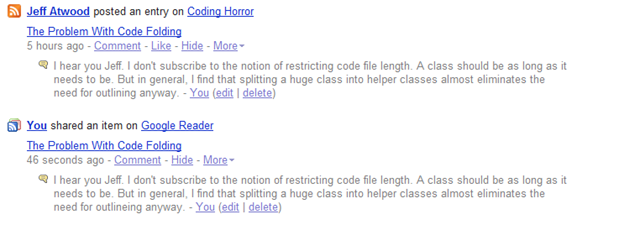
One thing that is surprising is that FF is slowing taking attention share away from Google Reader. Not just when it comes to commenting, but I post links that I find interesting. Steve Rubel, for example, tweets and posts links fairly often that point to interesting material – I share some. But those don’t show up in my Shared items to your right ( from Google Reader Shared items). I’m thinking of some way to integrate them together using the FF API.

Another reason is the Imaginary Friend feature. I currently only have one at the moment – MarsPhoenix. If that sounds familiar to you its that lander NASA just put on Mars’ north pole. Its got two blogs and a twitter feed. This Friend combines them into a one feed with posts from both blogs mixed in with the numerous tweet updates and makes it dead easy to follow via FF or RSS. These appear as fart of my feed on the FF homepage along with everything else, making it doubly useful.

FF is literally Google Reader gone wild (rather than Twitter). Its subscriptions based. And, one up on Google Reader, shares all of your online activity back to the community. Its not even Digg (I can’t remember the last time I logged in to Digg).

Many belive that Robert will be going on about another service in a few months time. But FF has the traction ( its many services and thus audiences that it serves) and the leverage (the huge number of adopters it has at the moment) to survive. It straddles the difference between a true, thoroughbred networking site like Twitter ( or Facebook, if you prefer) and the disconnected consumption of content of a RSS reader. Its perfectly situated to bridge the gap between all these disparate services.