
Data: Mine or Theirs?

Although I’m writing this under the fallout of  Scoble-Facebook, I don’t think the issue of who owns your data is either confined only to Digital identity or has been very well thought out.

First, a roundup of the various reactions:

It’s not about data portability. It’s about trust.

Offline, my friends and I share a mutual connection. Maybe it’s around work, maybe it’s around our kids or something in our past. Whatever it is, they’re my friend because they know something about me beyond what’s easily accessible to others. Keyword here is mutual. I know a bit about them too. Their relationship with me is unique as compared to their relationship with others.

Online, those lines are blurred. For what I would guess is at least 4,500 of the 5,000 “friends” Robert Scoble has on Facebook, he is the equivalent of a magazine publisher and you are his subscriber base/audience. He says it’s mutual and that’s the beauty of the social and connected web, but he only cares about you when you put something on the table that he’s interested in. It’s not about you. Yet, he’s “sitting” right next to your real friends, getting the same information about you that you’re sharing with them. If he takes that information and abuses it, however un- or good-intentioned, it serves you both right.

Robert Scoble valued his relationship with Plaxo more than he valued his relationship with his “friends,” otherwise he would have posted to them what he was doing with an experimental, alpha-quality and untested script before he did it…or he wouldn’t have done it at all.

Judi Sohn

I think there are two questions here. The first is whether users should be able to extract their data [including social graph data] from one service and import it into another. I personally believe the answer is Yes and this philosophy underlies what we’ve been working on at Windows Live and specifically the team I’m on which is responsible for the social graph contacts platform.

Dare Obasanjo

Then there is the oft-cited  post by Paul Buchheit (the guy who created Gmail).

Now I’m not on Facebook et al for a reason: data, in the case of a person,  is that person. Whereas data for iTunes is essentially  the signals sent to your sound card. Se the difference

Is it important to guard those things? Yes, or course. At the end of the day, its all you are left with if everything goes to hell: Your sense of self and identity, and your friends ( real friends, that is).

So we essentially have two options:

  1. Manage that data ourselves in a way that gives complete and utter control over every aspect of things
  2. Give our data over to a less than trustworthy service that essentially controls who you are, your identity ( on- and off-line) and who your freinds are and what your realtionship is with them

I’ll take option one any day of the week. Why? Becuase of control. It is all about control.

Plaxo may or may not keep your data after you opt-out ( i think its the former rather than the latter). Facebook has the awesome power of wiping out very single trace of you from its universe with a simple mouse-click. Add a hundred and one other web services that suck your data out of Google, Hotmail and the like.

There is a missing element in the above situations. Find it yet? And its not trust. Its control. And I mean, complete and utter control.

At least Twitter gives you more granular control( in terms of message recipients)  and has a proper API.

Better yet, Open ID, while somewhat flawed, is a brilliant idea insofar as you have a digital identity provided and vouchsafed by a trusted source ( AOL, for example). This blog is my digital identity ( since WP supports Open ID).  I can decide what to do with that identity, what to reveal, what to password protect. If I move on to from one blog to another, I can export all my posts and import them else where.

In short I have complete control of that Open ID identity (short of running my own webserver).

So because I have control I can never be in a Scoble snafu like that ( And I don’t care for the fact that Scoble was pressing FB’s buttons on purpose – he gave up his control over that data and he knew it).

In a  sense, its the MS DOS command line all over again. And  loss of control is like letting Vista hide the RUN command and the task manager and tickle itself silly with crashes.
DRM: Someone Check My Logic

Scoble has a post up suggesting that the RIAA is right and that we shouldn’t rip Cd’s.

1. Cause no one should copy Britney Spears, not to mention listen to her. The RIAA is doing us a service by making sure we don’t listen to her. Oh, and the RIAA is so brilliant that they brought us Britney in the first place (and now Hannah Montana) and that’s evidence enough that they are right and we should listen to them.
2. Because no one should be allowed to use music how they want. For instance, I hate using a CD player. Why? That requires me to get off the couch, find the darn CD and hope I put it away properly after that fun party, and then find the song I want instead of just opening iTunes from my couch and clicking on the right song. The RIAA is doing us a service by forcing us to get off the couch and get some exercise.
3. Bits have feelings too. Turning them from 0 to 1 hurts them.
4. They’ll force the kids to buy non-DRM music from the get go and not buy any CDs. Good for the environment! (My son, Patrick, says he only buys MP3’s or AAC’s without DRM now off of his online music stores).
5. This behavior will make sure people buy (or steal) music directly from bands. See how Radiohead did it. By doing that the price for music will go down thanks to fewer intermediaries. RIAA is just helping us get rid of them, which is good for everyone who loves music. See, they are on our side! I’m looking for a site that lets us do Vendor Relationship Management with bands. Doc Searls taught me about VRM. What is that? When we can get the company to do what WE want. Radiohead put the power of setting the price in OUR hands. Brilliant.
6. My son says that since they are making stealing music so dangerous (the kids are hearing the stories about parents getting sued for hundreds of thosuands of dollars) that they are getting paranoid about stealing music. So, what do they do instead? Have you heard of iPod trading? You will. Ahh, and we thought “sneaker net” was dead? Yeah, right. The RIAA brought it back.

On the plus side of this, I agree that music should NOT be copied to distribute. In other words, ripping music to a publicly accessible file sharing service or server is a no-no.

I mean it. We gotta remember that artist and records labels have to be compensated for all the work they do. And to ensure that they do, they have distribution networks set up – wether that is digital, CD, radio, etc.

So far so good.

I only buy CD’s. And I rip them for Personal Use. Let me emphasise that again- personal use.

And let be clear I have nothing against buying digital music off iTunes et al. The only problem is the DRM. Pure and simple.

DRM is the Black Death of the digital commodities industry today. When I buy a CD, I expect to be able to use the music across my home network, put it on my iPod and listen to it however I choose. The intrusion of DRM is nothing more than a source of frustration. So I buy CD’s to avoid the intrusion of DRM by iTunes and the like.

The limits of personal use are clearly defined. The barrier between personal use and piracy is just as clear.

So I propose the following: that the RIAA and the equivalent bodies in other countries trust the consumer.

Sounds radical. But think of this. Shouldn’t music and software companies be working together to find easier ways of identifying those who overstep the bounds of personal use? Instead of frustrating every Tom, Dick and Harry out there that want to enjoy the music, the pointy end of the stick should be firmly on those who overstep those clear bounds.

Amazon, eMusic – and to a lesser extent Apple- are trusting the consumer.

The RIAA just has to play catch up and face the music.

iPod Touch Week One

I’ve been listening to music too much and posting too little 🙂 .

The iPod Touch ( I prefer calling it the iTouch) is really good. Some songs come out sounding  better than they do on my speakers on the PC (Ok, not the best available speakers – JBL Creature).

The web browser is really really good. The whole JavaScript thing doesn’t work ( which you would expect since it is a full version of Safari, I belive). I mean what on earth were Apple thinking??? How many websites do  you  know of that don’t have Javascript???? I use it all the time in developing websites. Even if it’s not for visual stuff, java script can be doing a lot of heavy lifting in the background ( take, dare I say it, Facebook Beacon).

Looking at Google Reader in Classic mode is an experience somewhere between being eaten alive and having an out-of-body-experience of the event – can’t decide which is worse.  Trying to type and send an email in GoogleMail ( I tried), I found a strong urge to became a Chinese Citizen ( even the Great Firewall of China doesn’t stop Javascript) 🙂 . And by the way, I did finish the email and used by PC to find the addresses to send it to.

Though the Mobile mode is much, much better. I think its specially formatted for the iPhone/iTouch.

Viewing websites that don’t run on JavaScript or gracefully handled the fact that Javascript was off was pretty good. I think the lack of Javascript was one of the main reasons that Youtube is a separate application on the iTouch.

Don’t even get me started on Flash support

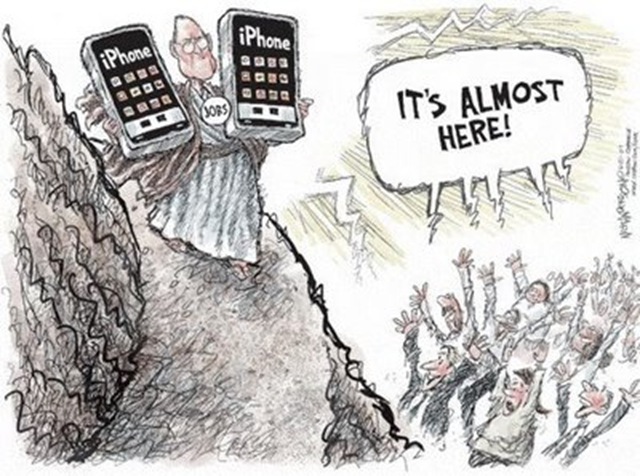
The integration with iTunes direct from the iTouch is a gift from heaven itself, from His Steveness to his faithful Apple flock 🙂

200706290853.jpg

Change that to an iTouch Comic and it would be perfect.

Youtube works seamlessly as well.

Now, the Syncing experience is something else. If I plug my iPod into my laptop instead of my PC ( keeping in mind I originally used my PC to Sync the iTouch), I get asked if I want to erase my iTouch and sync new music to it. Now my library is exclusively ripped CD’s that I’ve bought myself. Shouldn’t iTunes recognize that I already have music from the library ( both my laptop and PC use the same iTunes library out of a shared network location on my server) and shouldn’t it allow me to add, change or delete the playlists/music on my iTouch???

Now if there was a way to sync shared  library music (i.e from iTunes running over the server and sharing its library) to my iPod, there wouldn’t be this problem ( if there is, please post a comment. Thanks). 

Podcast subscriptions work great. Already subscribed to Scott Hanselmann.

Can’t complain about anything else. the design is great. the interface is supurb. Take how the screen gently coasts to a stop when you’ve finished scrolling. The whole flipping thing is really great. I’m getting used to it and its quite responsive when you know what to do.

My mother was using it quite well with out even being told what to do. She still asks me about emails.

Can’t wait for the SDK to come out. I’m assuming that the iPhone SDK is also for the iTouch. Can’t wait till I can say: “Pimp my iTouch”.

Dear Steve:

We hold these truths to be self-evidently pie in the sky, that all bloggers are created equal, that they are endowed by their Computers and iPhones with certain unalienable Rights, that among these are lots and lots of Links, [JavaScript, Flash] and the pursuit of AdSense Dollars

Ken Newsome

PS added in the bit about Javascript and Flash myself.

I Went Out and Bought One – iPod Touch

Does Steve Jobs have knack for designing things, or is it just me????

After ranting an raving here and else where about how I’d never buy an iPod unless DRM was sorted out, guess what? I Went Out and Bought One.

The Glasgow Apple Store is quite something. I was really impressed since I’d never been to an Apple store.  All the customer space is given over to Display models. There were iPhone between each iMac, MacBook, Apple TV, etc. The only retail items on display, as far as I could tell, were the iPod/iPhone accessories and the software. To get anything you ask one of the assistants who will get it for you from the back of the store. this works really well since it allows customers to focus on the devices. You can see Apple Design throughout the store.  

And I still can’t belive the sheer size of the 24″ iMac. It literally defies belief. I’ll put it this way, getting out of the store is far harder than getting in to it.

Picked up some earphones to go over my ears rather than inside them ( I can’t stand the standard earphones). And the guy got my iTouch. Purchasing was painless. The place felt like Steve himself had trained the staff and approved the decor.

And now my iTouch is charging after registering with iTunes. The one thing that really got me was that you can’t use it out-of-the-box. You need have an Internet connected PC running the latest version of iTunes and you can use it only after you  have registered it.

Since my library is mainly WMA files and stored on my Windows Home Server, I installed iTunes on the server and set it to work re-encoding my library and putting it in a dedicated iTunes shared folder. Fortunately I only have about 2000 songs so its not a lot *(Mind you, iTunes seems to have made it mind up that there are only 791 songs in said library. Hmmmm) . Its been running an hour and done nearly 400 songs, so a few hours and then I can sync music to  my iPod Touch.

Setting up Wi-Fi was painless insofar as I needed to change my key to make it slightly easer to type on the iPod because of the keyboard. The keyboard isn’t bad at all. In fact its a lot better that I  thought it was after reading various blogs on the subject. You can very easily hit the wrong key the first few times that you use it, but it quickly grows on you, and you get better and better at using it.

I’m impressed at the minimal  packaging of the iPod. The earphones had more by at least an order of magnitude.

The other thing is I strongly suggest you get a case. It looks rather fragile in the sense that it can be easily scratched. So I’m picking that up next week from said Apple Store.

All hail his Steveness…… 🙂

Amazon Kindle

Scoble says he’s under an NDA so can’t talk much, but does point us to this NewsWeek story about it.

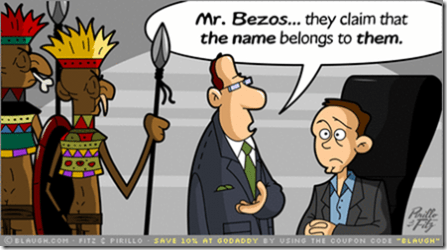
Another Pending Lawsuit for Amazon.com

Couldn’t resist 🙂

Here’s more from that that NewsWeek story (which seems to have it pretty much covered):

[Note: the whole story is worth a read. These re just the highlights.]

This week Bezos is releasing the Amazon Kindle, an electronic device that he hopes will leapfrog over previous attempts at e-readers and become the turning point in a transformation toward Book 2.0. That’s shorthand for a revolution (already in progress) that will change the way readers read, writers write and publishers publish.

Amazon has worked hard to get publishers to step up efforts to release digital versions of new books and backlists, and more than 88,000 will be on sale at the Kindle store on launch. (Though Bezos won’t get terribly specific, Amazon itself is also involved in scanning books, many of which it captured as part of its groundbreaking Search Inside the Book program. But most are done by the publishers themselves, at a cost of about $200 for each book converted to digital. New titles routinely go through the process, but many backlist titles are still waiting. “It’s a real chokepoint,” says Penguin CEO David Shanks.) Amazon prices Kindle editions of New York Times best sellers and new releases in hardback at $9.99. The first chapter of almost any book is available as a free sample.

The Kindle is not just for books. Via the Amazon store, you can subscribe to newspapers (the Times, The Wall Street Journal, The Washington Post, Le Monde) and magazines (The Atlantic). When issues go to press, the virtual publications are automatically beamed into your Kindle. (It’s much closer to a virtual newsboy tossing the publication on your doorstep than accessing the contents a piece at a time on the Web.) You can also subscribe to selected blogs, which cost either 99 cents or $1.99 a month per blog.

The subscriber charge for blogs definitely is a bad move since it limits your audience. I mean Scoble’s 600 feeds at $1.99 does turn out to be a lot of money. Even my modest reading list at 130 blogs makes reading on the Kindle prohibitive

Now comes the Kindle, which Amazon began building in 2004, and Bezos understands that for all of its attributes, if one aspect of the physical book is not adequately duplicated, the entire effort will be for naught. “The key feature of a book is that it disappears,” he says.

While those who take fetishlike pleasure in physical books may resist the notion, that vanishing act is what makes electronic reading devices into viable competitors to the printed page: a subsuming connection to the author that is really the basis of our book passion. “I’ve actually asked myself, ‘Why do I love these physical objects?’ ” says Bezos. ” ‘Why do I love the smell of glue and ink?’ The answer is that I associate that smell with all those worlds I have been transported to. What we love is the words and ideas.”

That is really important. I still buy my newspapers and books from a bookstore. Nothing beats the smell of ink and the texture of finely sliced and diced wood shavings ( 🙂 ).

Though the Kindle is at heart a reading machine made by a bookseller—and works most impressively when you are buying a book or reading it—it is also something more: a perpetually connected Internet device. A few twitches of the fingers and that zoned-in connection between your mind and an author’s machinations can be interrupted—or enhanced—by an avalanche of data. Therein lies the disruptive nature of the Amazon Kindle. It’s the first “always-on” book.

This leads to ever grander possibilities. I have on my bookshelf The Great war For Civilization: the Conquest of the Middle East (Ironically, I link to Amazon.com here), written pre-Gulf War 2. Wouldn’t it be absolutely marvelous if the book updated itself for a modest fee on publication of a second edition? Or if my Wrox ASP.Net 2.0 magically jumped versions to 3.0 0r 3.5? that would be great.

Updates, no problem—in fact, instead of buying a book in one discrete transaction, you could subscribe to a book, with the expectation that an author will continually add to it. This would be more suitable for nonfiction than novels, but it’s also possible that a novelist might decide to rewrite an ending, or change something in the middle of the story. We could return to the era of Dickens-style serializations. With an always-on book, it’s conceivable that an author could not only rework the narrative for future buyers, but he or she could reach inside people’s libraries and make the change. (Let’s also hope Amazon security is strong, so that we don’t find one day that someone has hacked “Harry Potter” or “Madame Bovary.”)

As usual, they beat me to the observation. I like the idea of returning to Dickens era serialization, it’s antiquated, almost – dare I say it- bookish.

But, nonetheless, this is an exciting step from Amazon. The whole idea is revolutionary ( if, that is, the implementation stands up to our high expectations).

Would I get one? Let’s wait for the announcement.

Random Thoughts for the Day

I might make this a regular thing.

  • I was at Costa’s this afternoon and a guy walks in with a  brand new iMac. Must have been at least a 20" if not more. never felt so jealous in my life. He must have got it from the Glasgow Apple Store. I’ve been meaning to go past, but haven’t had the time yet
  • My 19" Xerox TFT died today. Its a display model that I got slightly cheaper and have had it for 2 years. Its one of those lookers -black with a glass front so its completely flat. Damned thing. Multi-monitor setup anyone??
  • TCP/IP – spent the weekend doing revision on it. No wonder the Vista networking team re-wrote it.
  • Wouldn’t it be easier to replace RAM if you could plug the old or new RAM into a USB port and use it with ReadyBoost??? I mean, you need every megabyte of RAM you can find these days.
  • I keep thinking that you can do so much with technology around the home (RSS on your TV for example). Its just so difficult. Windows or Linux?? Windows Home Server??? Media Centre Edition??? Mac Mini with Front Row??
  • I’m starting to think that a separate machine running Media Centre Edition would be better than SageTv for Windows Home Server. I’m fighting SageTv tooth and nail to get it working properly ( EPG and all).It should be easier than this. Might get a refund
  • Could we please have a virtualisation hardware solution for small business/ home. It’d be cheaper than buying the MCE Server.
  • How many Vista Sidebar gadgets are actually useful??Google desktop is much, much better at useful gadgets. The mail gadgets for GD actually tells me when any new email arrives ( even if its automatically archived).
  • And could we please get a free sunclock for either sidebar?? You know, the ones that show where its day and where its night on a map of the world.
  • Also, back to sidebars, I’ve noticed that Google desktop loads its widgets off the Internet. You could theoretically see your widgets at any PC with GD installed if you’re logged in. Which is logical for Google in becoming the hub on which our lives revolve. I wouldn’t be surprised if they were building a HealthVault competitor – on the web of course.
  • I’m seriously considering the iPod Touch. DRM or no DRM. iTunes integration or no integration. The Design blows me away everytime. Why did el Jobso have to come up with a design that puts every other portable music player ( and iPod, mind you) to shame?????? And don’t tell me the iPhone is the best iPod to have. I think I’ll put that SageTv refund money to wards it if it comes to that)

Good Microsoft, Bad Google??

Taking a break from the innards of TCP/IP, I bring you two interesting blog posts.

First Verturebeat’s Matt Marshall asks: In history revision, Microsoft now a friend of the valley?

Second, Robert Cringely opines: The Future is Cloudy: Google’s plan to host ALL our applications.

Both may seem to be unrelated, but lets consider them both.

Matt says:

But now that Google has emerged as the all-pervasive menace, Microsoft has been transformed into an aging, less threatening knight, albeit with pockets and interests deep enough to help you against the Google onslaught. Microsoft’s alliance with Facebook — which calls for Microsoft to invest $240M in that company — has capped the transition.

Interesting inversion, don’t you think? Kind of like America springing to plucky little Britain’s aid after Pearl Harbor. In this case Microsoft’s Pearl Harbor was Google’s huge IPO and the raft of  highly successfully geek-drool-inducing products they released. And the Britons are everyone else in the Valley that have yet to go over the the Dark Side ( 🙂 ).

Think of the perceptive transformation that Microsoft has gone through. 3000 Microsoft Blogs (last I checked, which was while ago) and Robert Scoble have done loads to bring a human face to Microsoft. I remember once emailing Robert just after Office Live had its public debut for some specific details ( I was looking for a platform for a company web presence) and got a reply from the program manager 8 hours later.

Microsoft has done plenty to reach out to the community. Think of Mix06 and Mix07. The entire conference is on video with slides available from visitmix.org so anyone can take a look (I’ve still to get round to watch the sessions I downloaded 🙂 ).

Now take Robert Cringely. He looks at what Google’s Data Centre build out means, taken together with their MySQL contributions and their agreement with IBM to promote Cloud Computing to Universities.

By working with IBM to promote cloud computing to universities, Google is accomplishing two very important goals. It will first put them in touch with every graduate student doing work Google might find interesting. So it is first a hiring tool. But by teaching students about cloud computing Google and IBM are also seeding the technology in the companies where those students will take their first jobs after graduation. Five years from now cloud computing will be ubiquitous primarily for this reason.

But Google wants us to embrace not just cloud computing but Google’s version of cloud computing, the hooks for which will be in every modern operating system by mid-2009, spread not by Google but by a trusted open source vendor, MySQL AB.

Mid-2009 will also see the culmination of Google’s huge server build-out. The company is building data centers large and small around the world and populating them with what will ultimately be millions of generic servers. THAT’s when things will get really interesting. Imagine a much more user-friendly version of Amazon’s EC2 and S3 services, only spread across 10 or more times as many machines. And as with all its services, Google will offer free versions at the bottom for consumers and paid, but still cost-effective versions nearer the top for businesses and education.

Google’s goal here is to help us, of course, but along the way the company will have marginalized most higher-end computing vendors, especially Microsoft. They will have also made us totally dependent on Google services in such a way that we’ll never, ever, be able to extricate ourselves. We’ll be slaves, but happy slaves, and Google will come to dominate all computing for the next generation.

Now if Microsoft ever tried anything like this, I’d probably have to turn off comments to avoid the Death-To-Microsoft chants from the virtual mob.

This, of course, risks taking a left turn into the whole Dependency on Microsoft Question. But, for the sake of argument Leopard and Linus’ Every Flavor Linux settle that question just fine.

I use Google Mail for correspondence, Calendar for scheduling , Search for the obvious reason, iGoogle for my dashboard-view-on-the-world, Webmaster Tools.

What if we’re all reduce to running dumb terminal emulators connected to our Google-Instance on their servers? Fascinating idea, I’m sure. I mean what’s not to like about carrying your whole computer around with your Google Account and password (would save my shoulders lots of grief that’s for sure 🙂 )???

Taken with Google’s insatiable hunger for startups, is Google Microsoft-that-everyone-loves-to-hate 2.0???

Windows Vista- Day 4 On the Alien Planet

I have to say, now that most things are working, my opinion of Vista has improved loads.

Its the little details that I appreciate now. How taskbar items light up when you hover over them, for example

Windows Live installed perfectly on its fifth try, so I’m using Writer to type this.

Norton LiveUpdate works like a charm.

Windows update works well. I like the fact that Update is integrated within Vista instead of having a website to get all the optional stuff from.

My Gmail Notifier works like a charm.

The Windows Home Server Console does not work ( can’t log me in).

The SageTv Client works fine as well.

The Console itself installed fine ( I installed it before installing anything else, including updates), but can’t open my shares. Backup, strangely, works fine.

And accessing my shares is a pain. I have to use the IP address instead of the Computer Name. Which means I have to change the IP address on my media library every time it changes. At least till I get the DHCP Add-In working again( last time I tried, my PC’s refused to connect to the Internet).

So. how did I get this far after my frustrating first 2 days with Vista?

I tried everything to get the laptop networking working again. Scott Hanselman had a post a few week back entitled: The Nuclear Option: Resetting The Crap Out Of Your Network Adapters in Vista

This is for when “Diagnose and Repair” isn’t cutting it. Thanks to JohnP for his help.

  • Go to the Start Menu, type cmd and right click, and select “Run As Administrator”
  • Type the following commands, each followed by pressing enter.
    • ipconfig /flushdns
    • nbtstat -R
    • nbtstat -RR
    • netsh int reset all
    • netsh int ip reset
    • netsh winsock reset

Now, reboot and pray. Possibly not in that order.

I tried this in vain, twice. Clearly something was wrong since none of the above list of applications were able to access the Internet or local network.

So I went one better: I re-installed Vista from scratch. Now granted, it might seem like overkill to sort out a few networking issues, but those very networking issues prevented me from using my laptop to its full potential. This is because the use the network is such that we might as well not have the computer/network-enabled-device if we can’t use the network to its full.

The install was surprisingly quick and easy. And everything ran like a swizz car from there.

The one thing to note is that my Console and Shares( via the WHS Connector)  were working fine before any updates were installed. In other words, I could type in \\SERVER and my shares would come up. Currently I have to type in the IP address. So I’m pretty sure that an update is the culprit. though I have neither the time nor the patience to rollback each one to find out which it is.

All that aside, the Dell Inspiron 6400 is a very nice machine. It keeps up with everything quite well. And it has up to 7 hours of battery time ( if you select the power saver plan). It has media keys  on the edge that left you control Windows Media Player from  the keyboard, which is nifty. The really good thing is that its not ablaze with advertising stickers like some laptops I’ve seen lately.

In the final analysis, I’m really starting to like Vista after spending several hours with it reading 1000+ RSS items this afternoon(Google Reader subscribers will know what I mean).

So its back to writing software and salvaging erratic ship dates.

Windows Vista – Day 2 On The Alien Planet

Now Vista has given me a ride over the last couple of days.

I can understand why people are happy with XP. Or why they want to downgrade.

OK here goes:

  • Getting the laptop to connect to the Internet through my router has been a bit challenging.
    • This affects Live Update and any other programs that download stuff  ( or need to communicate with a remote server -like registering office)- thought, curiously not IE or Firefox
  • Getting programs to install can be challenging too
    • My WHS Connector can’t install because it can’t find my server (see above and below)
    • Windows tells me that there is a compatibility problem with Visual Studio 2005. When I install the Visual studio 2005 Service Pack for Vista, it tells me I haven’t got VS installed
    • Live writer failed to download and install
  • Restore removed Office and Nortons for some inexplicable reason
  • The number one thing is that accessing my server is a pain in the butt. Connector can see the server but not verify my password. Explorer can see it via the IP address but not via the name “server”

Somebody please tell me what I should do.